We often see brands running Meta ads in 2026, making the same structural mistake - treating creative production as an individual ad problem. By this, we mean looking to solve performance issues solely by launching a new video, testing a new hook, or iterating on a winner. It feels like rigorous testing. But, it is, in fact, the fastest way to starve Meta's algorithm of exactly what it needs to scale your account.
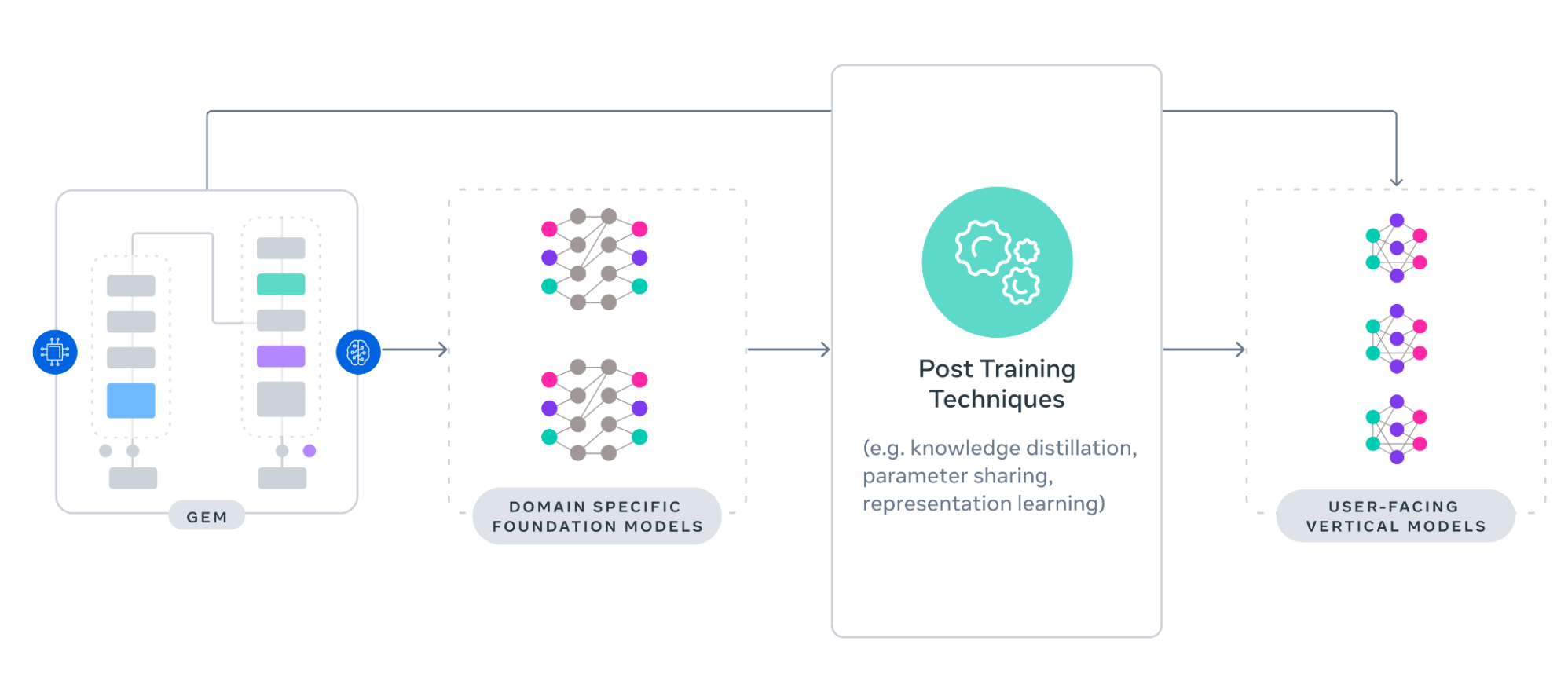
Meta's GEM model (the Generative Ads Model that now functions as the central brain of their ad recommendation system) doesn't evaluate your ads one by one. Instead, it looks to optimise sequences. It's looking at how different creative formats and engagement patterns interact across a user's journey to predict who should see what, and when. When your creative is homogeneous (by this, we mean the same format, same visual language, same structural approach etc) , you're essentially eliminating the signal diversity GEM requires to learn, adapt, and scale.
This is the distinction that separates accounts that grow profitably on Meta from accounts that plateau, inflate CPAs, and blame the algorithm.
GEM was introduced in November 2025 as a foundation model operating at LLM scale. Meta describes it as a paradigm shift, and that framing is super accurate. The previous system evaluated ads largely as isolated objects. GEM operates more like a discerning reader scanning both content and context simultaneously to generate predictions about who will respond to a given ad, at a given moment, in a given sequence of prior exposures.
We spoke with Maxim from Meta recently on D2C Diaries, and he describes GEM by extending the librarian analogy he uses for Andromeda
In his words, the two systems work together: Andromeda filters the best content, while GEM predicts how to deliver that content to the right person at the right time. So essentially: Andromeda = retrieval (the librarian selecting the best ads), and GEM = ranking (the discerning reader that knows when and to whom to serve them).
You can watch the full episode here:
The performance numbers Meta published alongside the launch reflect the scale of the change: a 5% lift in conversions on Instagram, 3% on Facebook Feed, and 4x the efficiency gains versus the previous ranking models.
The critical word in all of this is sequence. GEM doesn't ask whether this is a good ad. Instead, it asks: given everything this user has seen, what should they see next, and from whom? That means the value of any individual creative isn't fixed... it's contextual, andiIt depends on what else exists in your account for GEM to sequence it alongside.
Brands that understand this build creative ecosystems. Brands that don't build creative silos. And creative silos — even high-quality ones — produce weak sequence signals.
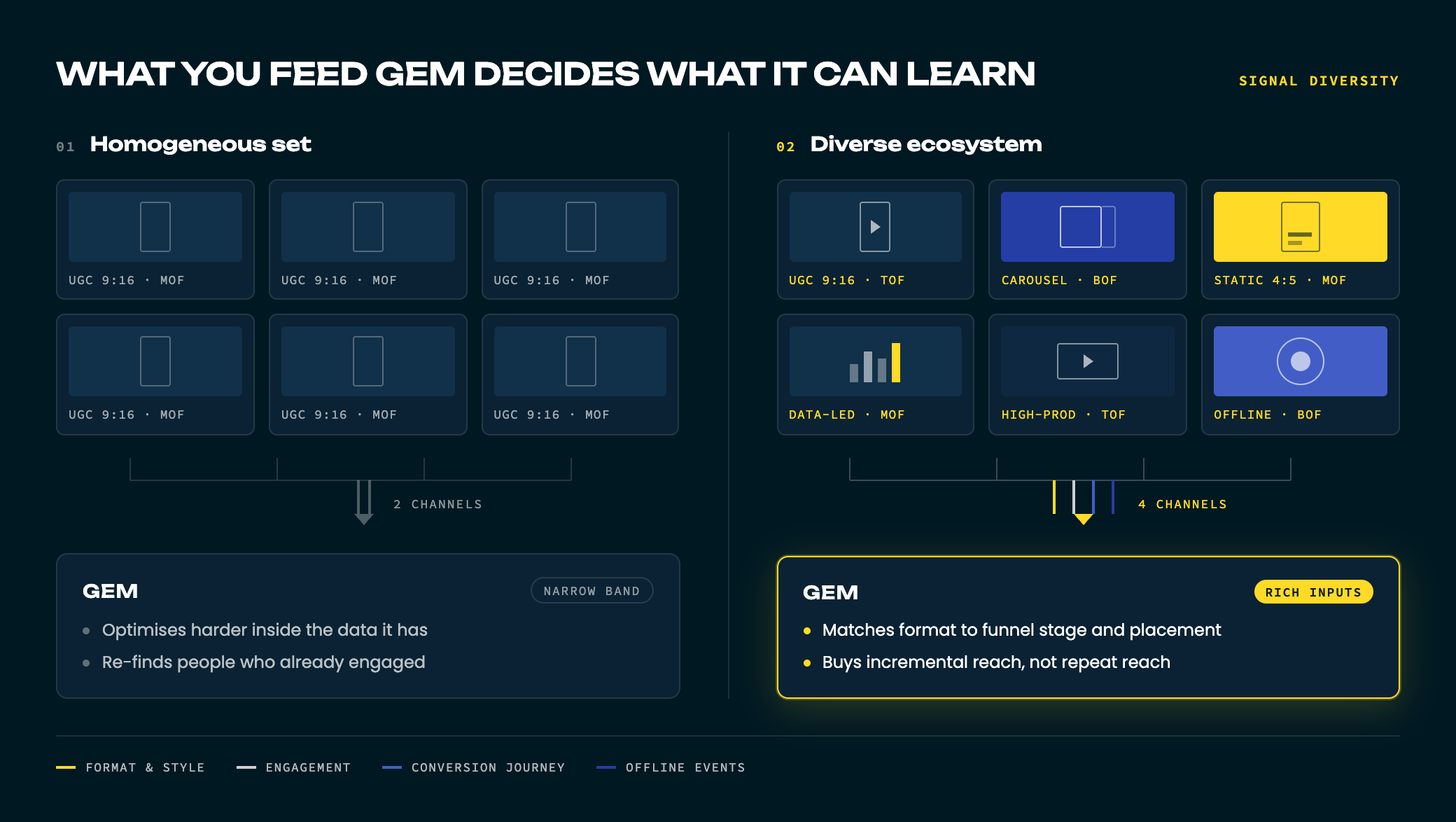
GEM rewards four specific types of signal diversity: creative format and style, user engagement patterns, multi-step conversion journey data, and offline event signals.
When those signals are varied and rich, the model has meaningful information to work with. It can identify which creative types resonate at which stage of the funnel, for which audience segments, across which placements.
When those signals are narrow e.g. because you're running three variations of the same UGC testimonial format, or iterating endlessly on slight hook changes within the same visual template, it has very little to differentiate. For example, it can't learn that video format A performs better for cold audiences while carousel format B drives better retargeting signals. It can't identify that a certain aesthetic is pulling a specific persona that your dominant creative style is missing entirely. It simply optimises harder within the narrow band of data it has, which usually means finding the same people who've already engaged with your ads repeatedly.
This is the mechanism behind what we see in accounts that have hit a creative ceiling: not a sudden drop in performance, but a slow, grinding narrowing of reach and efficiency. GEM is doing exactly what it's supposed to, but it's just working with insufficient inputs.
The fix isn't to spend more or restructure campaigns. It's to fundamentally change what you're feeding into the system. Creative diversity isn't a creative brief concept - it's an algorithm input.
GEM doesn't operate in isolation.
It sits within Meta's broader Lattice architecture - the model system introduced in December 2025 that consolidates thousands of individual objective-specific models into unified systems that share knowledge across goals. Lattice produced a 10% improvement in top-line metrics, an 11.5% improvement in ad quality scores, and a 6% boost in conversion rate at launch.
What Lattice means for your creative strategy is this: poor signals don't just hurt you within one objective or one campaign, they get deprioritised across multiple models simultaneously. If your creative is generating weak engagement signals in prospecting, that information flows across the shared model architecture and influences how your account is treated in retargeting, in lookalike expansion, across placements.
The inverse is equally true, and this is where the real opportunity sits. Strong, diverse creative signals compound across the entire system. An account with rich signal diversity (formats, styles, funnel stages, audience responses) is giving Lattice's interconnected models more high-quality data to work with everywhere. The accounts that feed GEM and Lattice well don't just perform better in isolation; they build a compounding learning advantage over time that widens every month.
This is why accounts investing seriously in performance creative at the system level, not just producing good individual ads, consistently outperform their category benchmarks over 6 to 12 month periods. The algorithm rewards input quality with compounding output quality.
Here's the practical consequence of running a narrow creative diet in a GEM-optimised system.
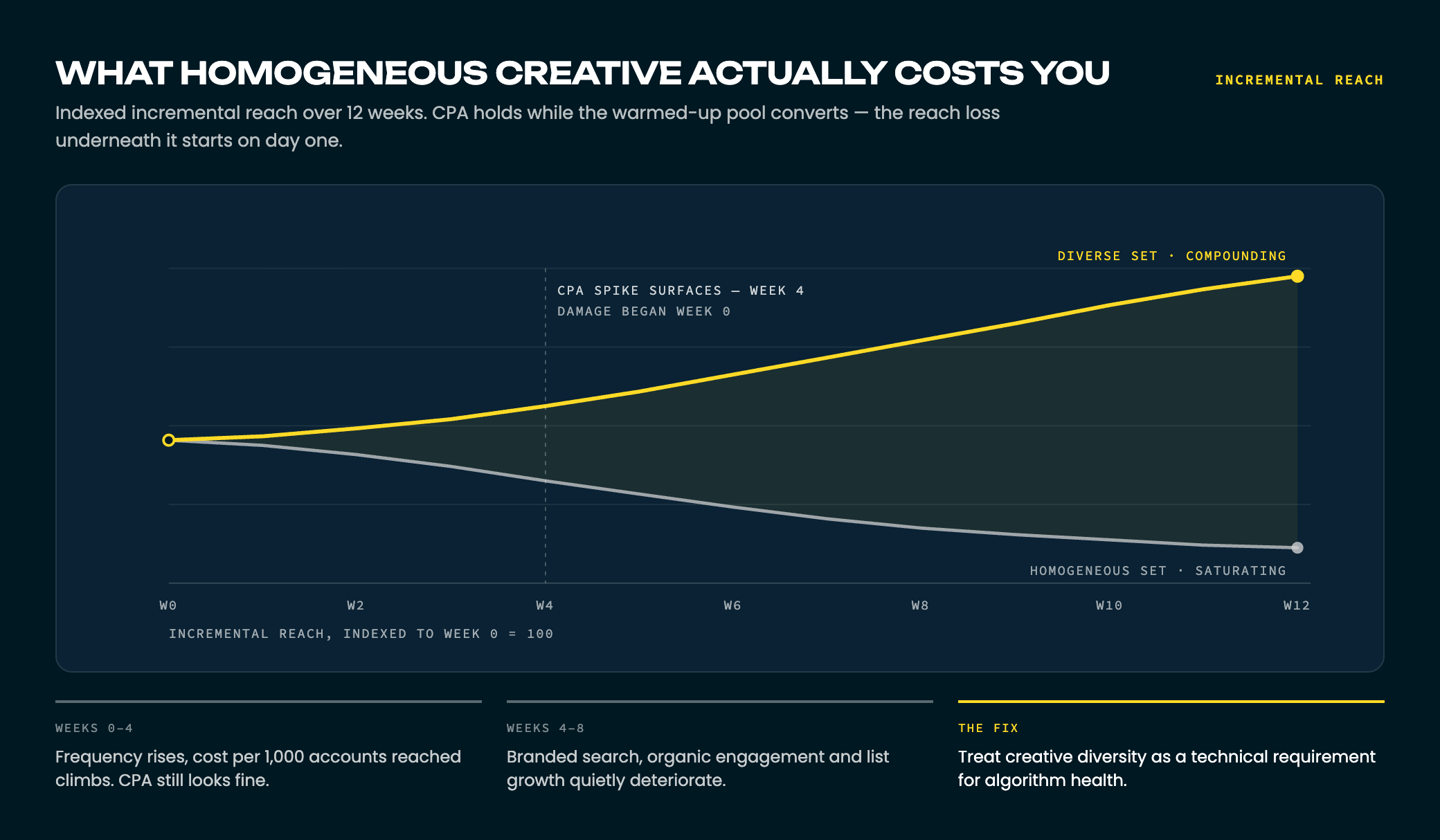
The algorithm identifies the narrow band of users most likely to respond to your dominant creative style. It optimises delivery toward those users. Frequency rises. Your cost per 1,000 accounts reached climbs. Your impressions are increasingly going to people who have already seen your ads multiple times.
On the surface, your CPA might hold for a few weeks - you're still converting the warmed-up pool. But incremental reach is collapsing underneath. You're not filling the top of the funnel with new people, which means everything downstream, like branded search volume, organic engagement, and email list growth, quietly deteriorates. By the time it shows up as a CPA spike, you're already three to four weeks into the damage.
The brands that avoid this cycle treat creative diversity as a technical requirement for algorithm health, not a creative preference. The full framework for how we approach this - including how GEM and Lattice interact with Meta's Andromeda retrieval system - is covered in our 2026 Meta Performance Playbook, which maps out what a signal-rich creative system actually looks like in practice.
The question of which creative types are missing from your account is also directly tied to persona coverage. If your creative set only resonates with one or two audience segments, GEM is only learning about one or two audience segments. Mapping your micro-personas is the fastest way to identify the gaps — and closing those gaps is what gives GEM the range it needs to expand delivery beyond your saturated core.
The practical output of understanding GEM's sequence optimisation logic is a different creative brief. Instead of asking what the best version of your winning ad looks like, the question becomes: what does your creative set look like as a system and what signals is it capable of generating?
Audit your active creative against four dimensions: format variety (static, video, carousel, UGC, produced), funnel stage coverage (cold awareness through purchase intent), visual and tonal range (not just different hooks on the same visual template), and persona coverage (how many distinct audience segments does your creative speak to directly). If the honest answer across those four dimensions is narrow, you've identified why GEM has limited learning opportunities in your account.
The goal isn't to produce more of everything. It's to produce strategically different creative that expands the signal space you're giving the algorithm. A single new format that reaches a genuinely different persona segment is worth more to GEM than five more variations on your existing winner. For the methodology we use to build and evaluate this kind of creative system across client accounts, our guide to creative testing on Meta covers the full approach.
The accounts that win on Meta in the GEM era aren't the ones with the best individual ads. They're the ones giving the algorithm the richest possible signal environment to work from. That's a production strategy, a testing strategy, and a creative strategy - all at once. Most brands are only thinking about one of the three.

We often see brands running Meta ads in 2026, making the same structural mistake - treating creative production as an individual ad problem. By this, we mean looking to solve performance issues solely by launching a new video, testing a new hook, or iterating on a winner. It feels like rigorous testing. But, it is, in fact, the fastest way to starve Meta's algorithm of exactly what it needs to scale your account.
Meta's GEM model (the Generative Ads Model that now functions as the central brain of their ad recommendation system) doesn't evaluate your ads one by one. Instead, it looks to optimise sequences. It's looking at how different creative formats and engagement patterns interact across a user's journey to predict who should see what, and when. When your creative is homogeneous (by this, we mean the same format, same visual language, same structural approach etc) , you're essentially eliminating the signal diversity GEM requires to learn, adapt, and scale.
This is the distinction that separates accounts that grow profitably on Meta from accounts that plateau, inflate CPAs, and blame the algorithm.
GEM was introduced in November 2025 as a foundation model operating at LLM scale. Meta describes it as a paradigm shift, and that framing is super accurate. The previous system evaluated ads largely as isolated objects. GEM operates more like a discerning reader scanning both content and context simultaneously to generate predictions about who will respond to a given ad, at a given moment, in a given sequence of prior exposures.
We spoke with Maxim from Meta recently on D2C Diaries, and he describes GEM by extending the librarian analogy he uses for Andromeda
In his words, the two systems work together: Andromeda filters the best content, while GEM predicts how to deliver that content to the right person at the right time. So essentially: Andromeda = retrieval (the librarian selecting the best ads), and GEM = ranking (the discerning reader that knows when and to whom to serve them).
You can watch the full episode here:
The performance numbers Meta published alongside the launch reflect the scale of the change: a 5% lift in conversions on Instagram, 3% on Facebook Feed, and 4x the efficiency gains versus the previous ranking models.
The critical word in all of this is sequence. GEM doesn't ask whether this is a good ad. Instead, it asks: given everything this user has seen, what should they see next, and from whom? That means the value of any individual creative isn't fixed... it's contextual, andiIt depends on what else exists in your account for GEM to sequence it alongside.
Brands that understand this build creative ecosystems. Brands that don't build creative silos. And creative silos — even high-quality ones — produce weak sequence signals.
GEM rewards four specific types of signal diversity: creative format and style, user engagement patterns, multi-step conversion journey data, and offline event signals.
When those signals are varied and rich, the model has meaningful information to work with. It can identify which creative types resonate at which stage of the funnel, for which audience segments, across which placements.
When those signals are narrow e.g. because you're running three variations of the same UGC testimonial format, or iterating endlessly on slight hook changes within the same visual template, it has very little to differentiate. For example, it can't learn that video format A performs better for cold audiences while carousel format B drives better retargeting signals. It can't identify that a certain aesthetic is pulling a specific persona that your dominant creative style is missing entirely. It simply optimises harder within the narrow band of data it has, which usually means finding the same people who've already engaged with your ads repeatedly.
This is the mechanism behind what we see in accounts that have hit a creative ceiling: not a sudden drop in performance, but a slow, grinding narrowing of reach and efficiency. GEM is doing exactly what it's supposed to, but it's just working with insufficient inputs.
The fix isn't to spend more or restructure campaigns. It's to fundamentally change what you're feeding into the system. Creative diversity isn't a creative brief concept - it's an algorithm input.
GEM doesn't operate in isolation.
It sits within Meta's broader Lattice architecture - the model system introduced in December 2025 that consolidates thousands of individual objective-specific models into unified systems that share knowledge across goals. Lattice produced a 10% improvement in top-line metrics, an 11.5% improvement in ad quality scores, and a 6% boost in conversion rate at launch.
What Lattice means for your creative strategy is this: poor signals don't just hurt you within one objective or one campaign, they get deprioritised across multiple models simultaneously. If your creative is generating weak engagement signals in prospecting, that information flows across the shared model architecture and influences how your account is treated in retargeting, in lookalike expansion, across placements.
The inverse is equally true, and this is where the real opportunity sits. Strong, diverse creative signals compound across the entire system. An account with rich signal diversity (formats, styles, funnel stages, audience responses) is giving Lattice's interconnected models more high-quality data to work with everywhere. The accounts that feed GEM and Lattice well don't just perform better in isolation; they build a compounding learning advantage over time that widens every month.
This is why accounts investing seriously in performance creative at the system level, not just producing good individual ads, consistently outperform their category benchmarks over 6 to 12 month periods. The algorithm rewards input quality with compounding output quality.
Here's the practical consequence of running a narrow creative diet in a GEM-optimised system.
The algorithm identifies the narrow band of users most likely to respond to your dominant creative style. It optimises delivery toward those users. Frequency rises. Your cost per 1,000 accounts reached climbs. Your impressions are increasingly going to people who have already seen your ads multiple times.
On the surface, your CPA might hold for a few weeks - you're still converting the warmed-up pool. But incremental reach is collapsing underneath. You're not filling the top of the funnel with new people, which means everything downstream, like branded search volume, organic engagement, and email list growth, quietly deteriorates. By the time it shows up as a CPA spike, you're already three to four weeks into the damage.
The brands that avoid this cycle treat creative diversity as a technical requirement for algorithm health, not a creative preference. The full framework for how we approach this - including how GEM and Lattice interact with Meta's Andromeda retrieval system - is covered in our 2026 Meta Performance Playbook, which maps out what a signal-rich creative system actually looks like in practice.
The question of which creative types are missing from your account is also directly tied to persona coverage. If your creative set only resonates with one or two audience segments, GEM is only learning about one or two audience segments. Mapping your micro-personas is the fastest way to identify the gaps — and closing those gaps is what gives GEM the range it needs to expand delivery beyond your saturated core.
The practical output of understanding GEM's sequence optimisation logic is a different creative brief. Instead of asking what the best version of your winning ad looks like, the question becomes: what does your creative set look like as a system and what signals is it capable of generating?
Audit your active creative against four dimensions: format variety (static, video, carousel, UGC, produced), funnel stage coverage (cold awareness through purchase intent), visual and tonal range (not just different hooks on the same visual template), and persona coverage (how many distinct audience segments does your creative speak to directly). If the honest answer across those four dimensions is narrow, you've identified why GEM has limited learning opportunities in your account.
The goal isn't to produce more of everything. It's to produce strategically different creative that expands the signal space you're giving the algorithm. A single new format that reaches a genuinely different persona segment is worth more to GEM than five more variations on your existing winner. For the methodology we use to build and evaluate this kind of creative system across client accounts, our guide to creative testing on Meta covers the full approach.
The accounts that win on Meta in the GEM era aren't the ones with the best individual ads. They're the ones giving the algorithm the richest possible signal environment to work from. That's a production strategy, a testing strategy, and a creative strategy - all at once. Most brands are only thinking about one of the three.


.svg)