Something fundamental has changed about how people experience the internet.
The feed someone scrolls at 7am looks nothing like the one their partner sees. The ads that stop one person mid-scroll are invisible to another. Every platform is building a personalised reality for every individual user, shaped by years of behavioural data: what they watched, what they skipped, what they paused on, what they bought, what they quietly scrolled past three times before finally clicking.
Meta isn't finding audiences anymore. It's matching moments. A specific piece of creative, to a specific person, at a specific point in their decision-making journey.
Andromeda uses visual pattern matching to categorise creative. Ads that look similar, even with different hooks or copy, get grouped as one entity. GEM then optimises delivery of that entity toward proven converters, the same cluster of people, repeatedly. Lattice amplifies whatever patterns already exist in the account.
The result: Meta's AI gets very good at finding the people your current creative attracts, and completely ignores everyone else.
Which means the old model, one message, one audience, one funnel, is no longer a strategic choice. It's a structural disadvantage.
The brands winning right now are the ones feeding the algorithm enough distinct signals to find genuinely different people. Not ten versions of the same ad. Genuinely different stories, for genuinely different emotional states, built on genuinely different persona intelligence.
The brands still scaling spend without solving this are producing blind volume. More ads, same signal. The algorithm finds the same people faster, not new ones. Incremental reach doesn't come from more creative. It comes from more distinct personas giving the algorithm genuinely different territory to find.
Persona diversity means building creative for people who experience the same problem in fundamentally different ways, at different awareness levels, with different emotional blocks, and different cognitive biases. That's what generates new signals and what drives net-new customers.
This is a practical breakdown of how persona-led creative strategy actually works at the account level. I'll walk through the psychological frameworks we use at Hambi to build genuine signal diversity, show you exactly what a micro-persona looks like versus a macro one, and give you a real example of how the same product brief forks into three completely different ads for three completely different people.
By the end, you'll understand:
Time to read: approximately 8 minutes.
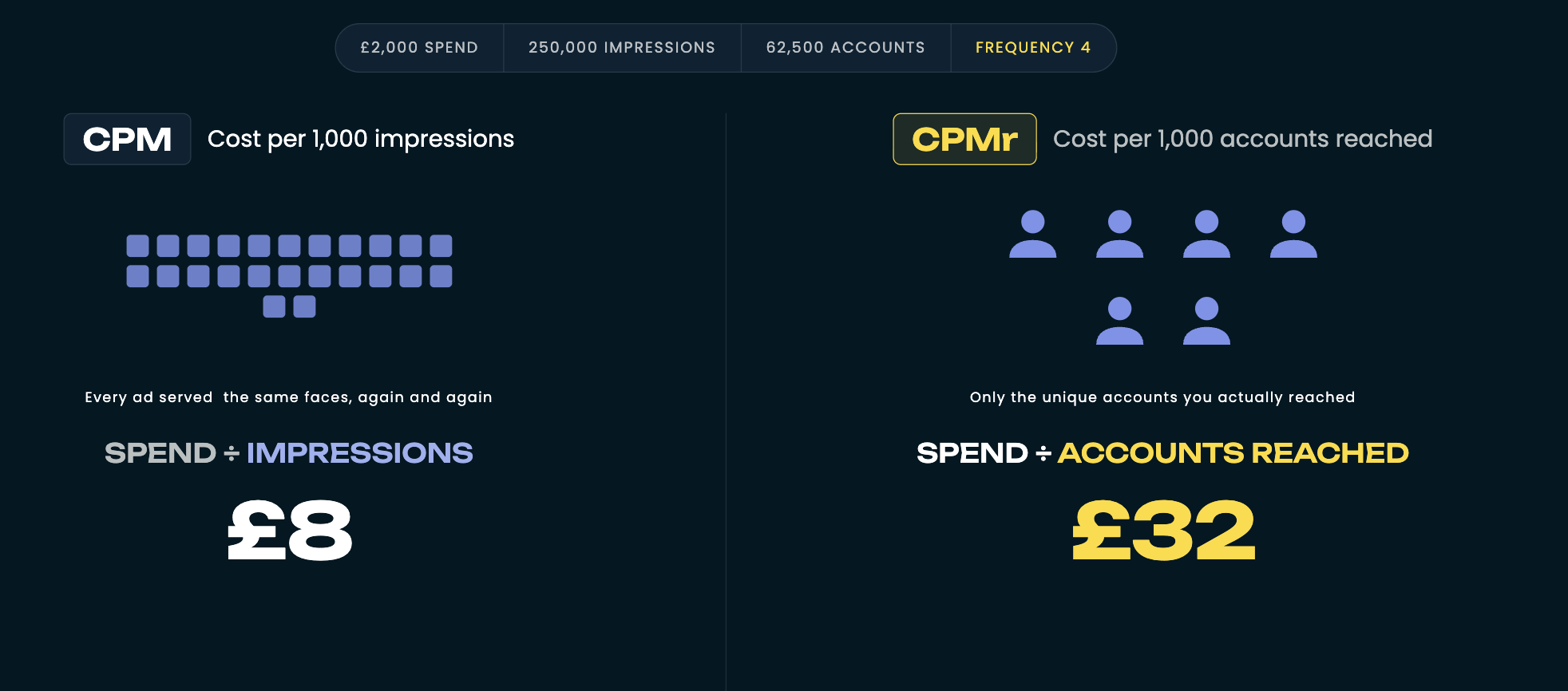
FTIR is sitting at 24%. CPMs have been climbing for six weeks. The creative team launched 30 new ads last month and the performance curve hasn't moved.
Someone suggests increasing the budget. Someone else wants to test new hooks. You run the numbers and nothing points to a clear answer, because the data is telling you the account is working, just not for anyone new.
This is the moment most brands misdiagnose.
They look at media spend, bid strategy, audience exclusions. They brief more creative. Some of them find a winning hook and ride it until frequency kills it, then start the cycle again.
What they don't look at is the persona layer. Specifically, whether the creative they're producing is genuinely signalling to different people, or just saying the same thing in different packaging.
Because Andromeda doesn't care how many ads you have in market. It cares how many distinct psychological territories those ads are covering. If the answer is one or two, you're not running 30 ads. You're running the same ad 30 times, paying more each week for the privilege of showing it to the same cluster of people.
That's not a Meta problem. That's a persona problem. And it starts long before the brief.
.png)
This comes up constantly in conversations with brands hitting frequency walls. In a recent episode of D2C Diaries, we spoke with a Meta insider about exactly this, what to do when frequency is rising and you need to unlock new audiences. Their advice cuts straight to it: stop thinking like a marketer and start thinking like a consumer. Not at the demographic level, but at the psychological and emotional level. The moment an ad feels like it knows you rather than targets you, everything changes.
At Hambi Media, we operate under a philosophy called soulmate theory. The idea is simple: there is a perfect creative for every single person. Not a good creative, the perfect one. The exact piece of content that speaks so directly to who they are, what they're feeling, and what they need right now, that it stops them mid-scroll and gets them to convert.
Our job is to make that creative. And the reason most brands aren't doing it is because they're starting in the wrong place: demographics.
Demographics can't get you to soulmate.
When we audit ad accounts, the persona document is almost always the first problem. It tends to say something like: Sarah, 30-45, stressed mum, overwhelmed with work and home life, values calm and wellbeing. The team briefs creative against it. Nothing breaks through. They assume it's a budget problem or a bidding problem.
It's almost always a signal problem. With Andromeda, the signals inside your ad are the brief to the algorithm and spend is the prompt. If the persona those signals are built on is shallow, you find the wrong people, or the same people, repeatedly, at rising CPMs.
A typical persona document gives you age range, personality description, interests, problem states. It looks complete. Through the lens of what Andromeda needs, there are important gaps.
.png)
There's no awareness level. Is she problem-aware but doesn't know solutions exist? Has she tried three products that didn't work? Is she actively comparing you against a competitor? Each is a fundamentally different person who needs a fundamentally different ad.
There are no core fears. Feels overwhelmed is a symptom. The fear that actually drives behaviour is more specific: the fear that her outbursts are permanently damaging her relationship with her children. That's a different brief, a different hook, a different emotional register.
There's no account of prior failures. If she's spent £200 on supplements that did nothing, she's in your funnel with her defences up. If your ad doesn't speak to that sceptic, it runs straight into her walls.
There's no cognitive bias mapping. Some users need social proof. Some need authority and clinical data. Some need identity reinforcement. Without knowing which lever applies, creative averages across all of them and averaging doesn't convert anyone well.
.png)
A persona without these layers gives Andromeda one psychological territory and asks it to run everywhere.
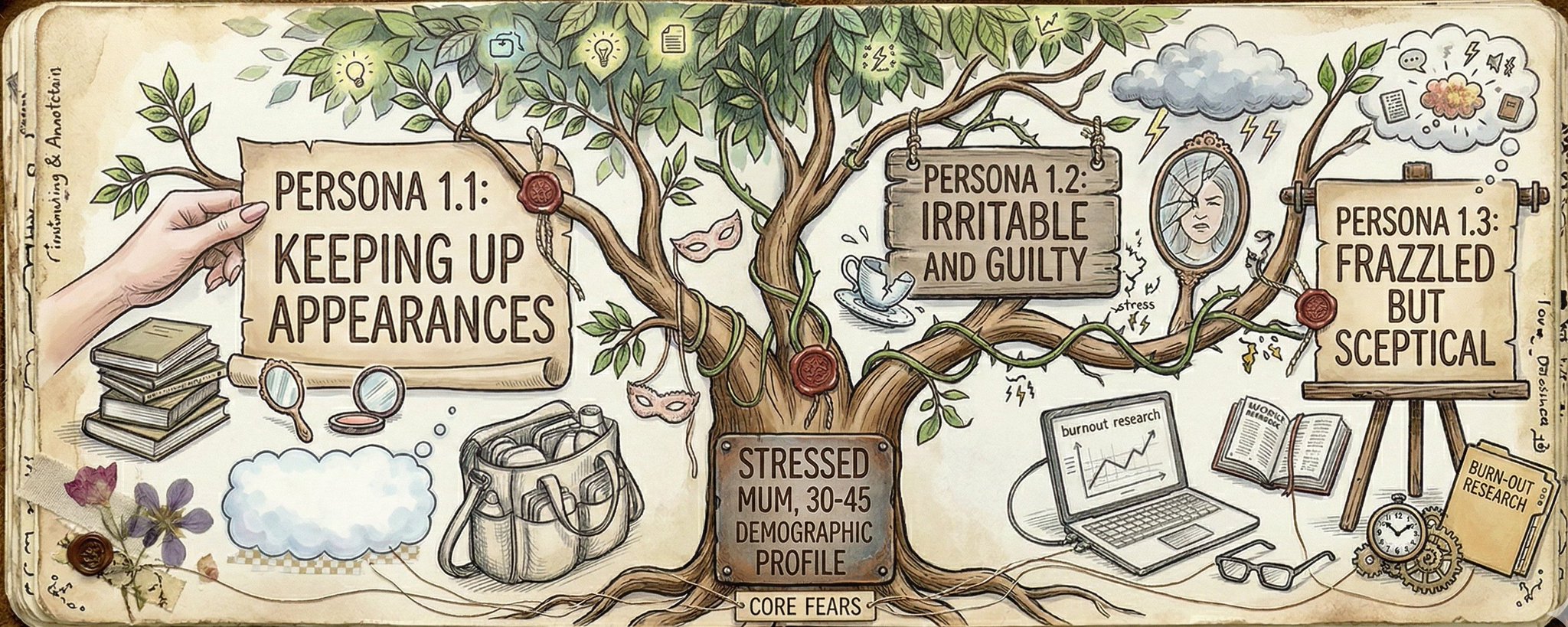
Stressed mum, 30-45 isn't a person. It's three or four psychologically distinct people who share a demographic profile. The shift from macro to micro is a shift from demographic description to psychological architecture.
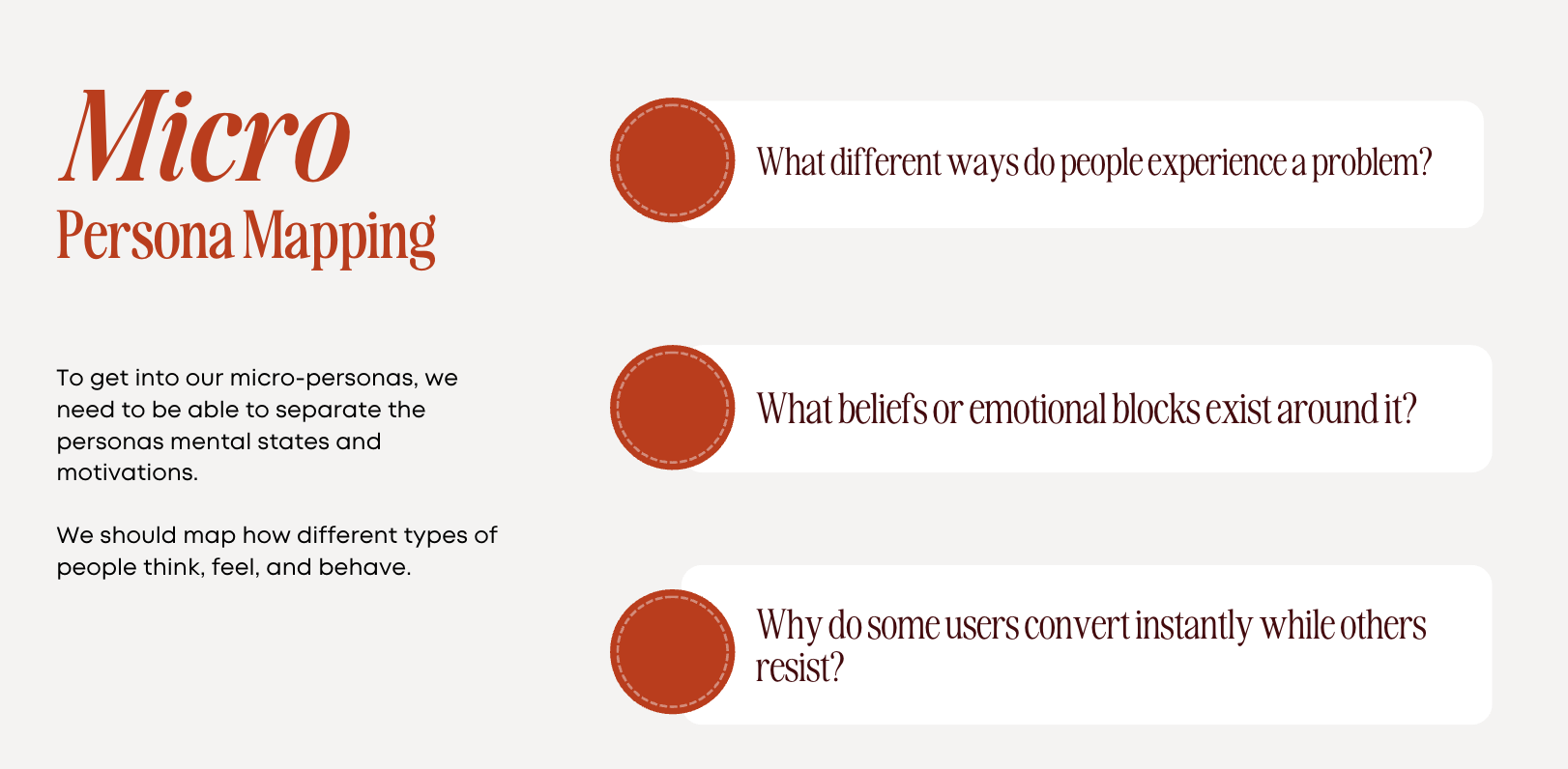
Three questions separate out the mental states within a segment:
What different ways do people experience this problem? The stressed mum who hasn't identified stress management as the solution is experiencing her problem differently to the one who's been researching for six months.
What beliefs or emotional blocks exist? The woman who thinks she needs to be more organised has a different block to the one who's tried apps, breathing exercises, and three supplements that didn't work.
Why do some users convert instantly while others resist? This leads directly to cognitive bias, the mechanism that moves each sub-segment from consideration to action.
Most teams build personas on gut feeling. The ones that scale build them on signal: language and behaviour their customers are already producing.
Customer reviews. Export your last 500 and look for recurring phrases describing a change in life state. If 20% of reviewers mention using a commuter backpack as a baby changing bag because of the easy-wipe lining, you've found a micro-persona your demographic brief missed entirely. Use that language verbatim, don't paraphrase it.
Comments and organic social. Look for the yes, but comments on your top organic posts. Looks great, but is it actually sweat-proof for heavy cardio? That's a persona. Your next brief: to the person asking if this is sweat-proof for heavy cardio, watch this. A doubt becomes a sceptic brief.
Competitor ad libraries. Look for the personas your competitors aren't running. If everyone briefs the same creator archetype, there's likely an underserved audience node with lower CPMs waiting for whoever gets there first.
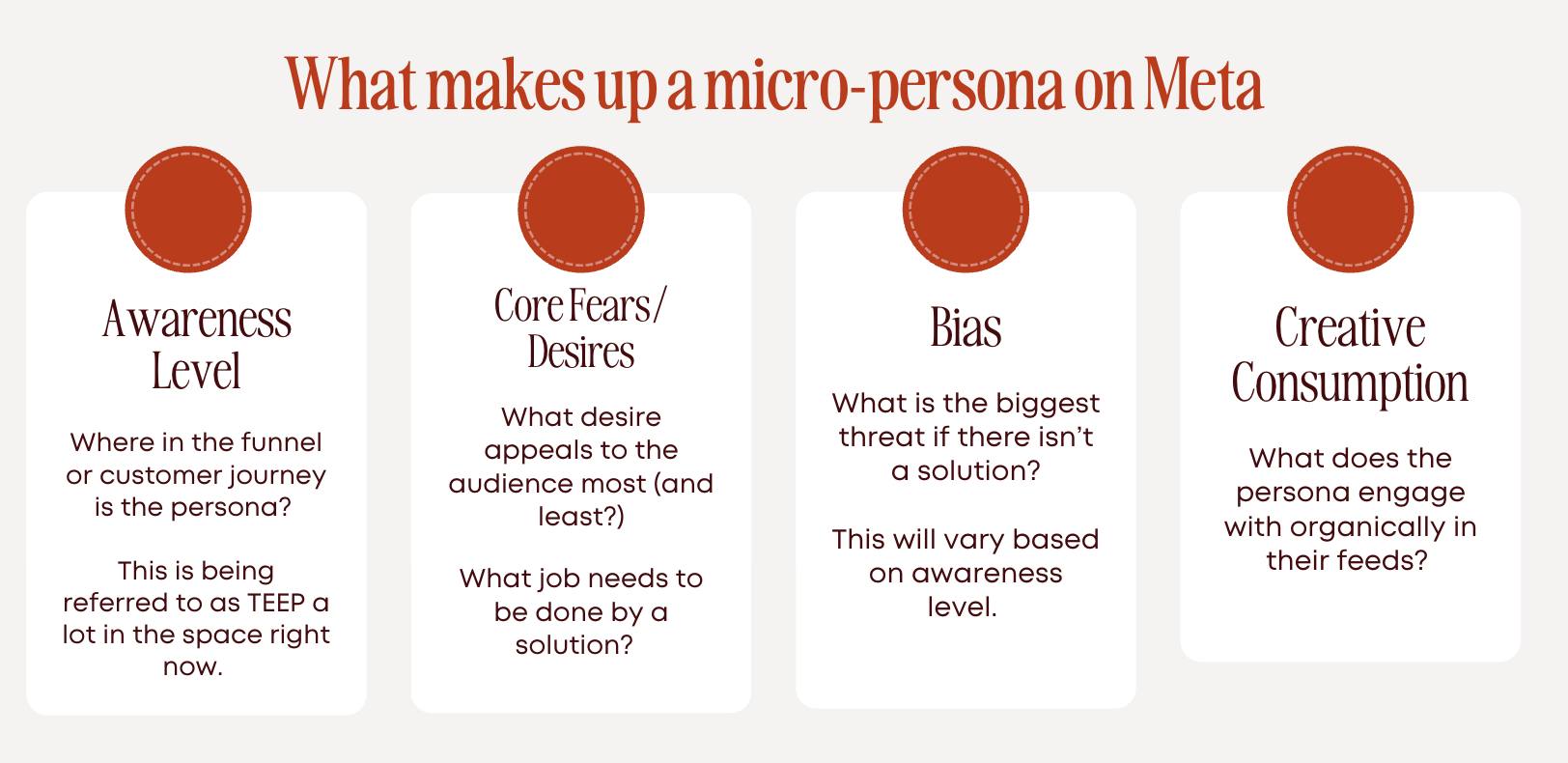
Awareness level (TEEP): Trigger, Exploration, Evaluation, Purchase. This determines hook strategy, education depth, proof requirements, and CTA intensity. Speaking to someone in Evaluation mode as if they've just discovered the problem is probably the single biggest driver of wasted spend.
Core fears and desires: Wants less stress is not a core desire. Wants to be emotionally present during the limited years her kids still want to hug her is, and it writes a completely different ad.
Cognitive bias: Which psychological shortcut is this person most likely to respond to? Social proof for one persona, authority and clinical data for another, identity reinforcement for a third.
Creative consumption. The creative that converts her needs to look and feel like something she already chooses to watch and avoid the format she scrolls past because it looks like an ad.
To translate this into an actual creator brief, you also need:
The Authentic Archetype: a specific, named role a creator can inhabit. The Overwhelmed First-Time Mum. The more specific, the more precisely Andromeda categorises it.
The Aesthetic Environment: what the background looks like. A minimalist kitchen signals a different audience than a cluttered family home. The scenery is part of the signal.
The Internal Monologue: the exact vocabulary this person uses, pulled from reviews and Reddit threads. The thought she has right before she searches for a solution. Use her words.
The Anti-Persona: what this persona is actively rejecting. Calling that out in the creative is often exactly what makes her stop scrolling.
Trigger awareness. She's struggling but hasn't identified stress management as the solution. She thinks she just needs to try harder.
Core fear: being seen as a bad mum who can't keep it together.
Digital footprint: Mrs Hinch, Steph Douglas, productivity influencers.
The creative that converts her is peer-led social proof. A clinical ad on cortisol mechanisms does nothing.
Exploration awareness. She knows she needs help but is overwhelmed by options.
Core fear: her irritability is permanently damaging her relationship with her children.
Digital footprint: Dr. Becky Kennedy, The Motherkind podcast, Mindful Mamas Facebook groups.
The creative that converts her is emotionally resonant, identity-led. Authority doesn't move her.
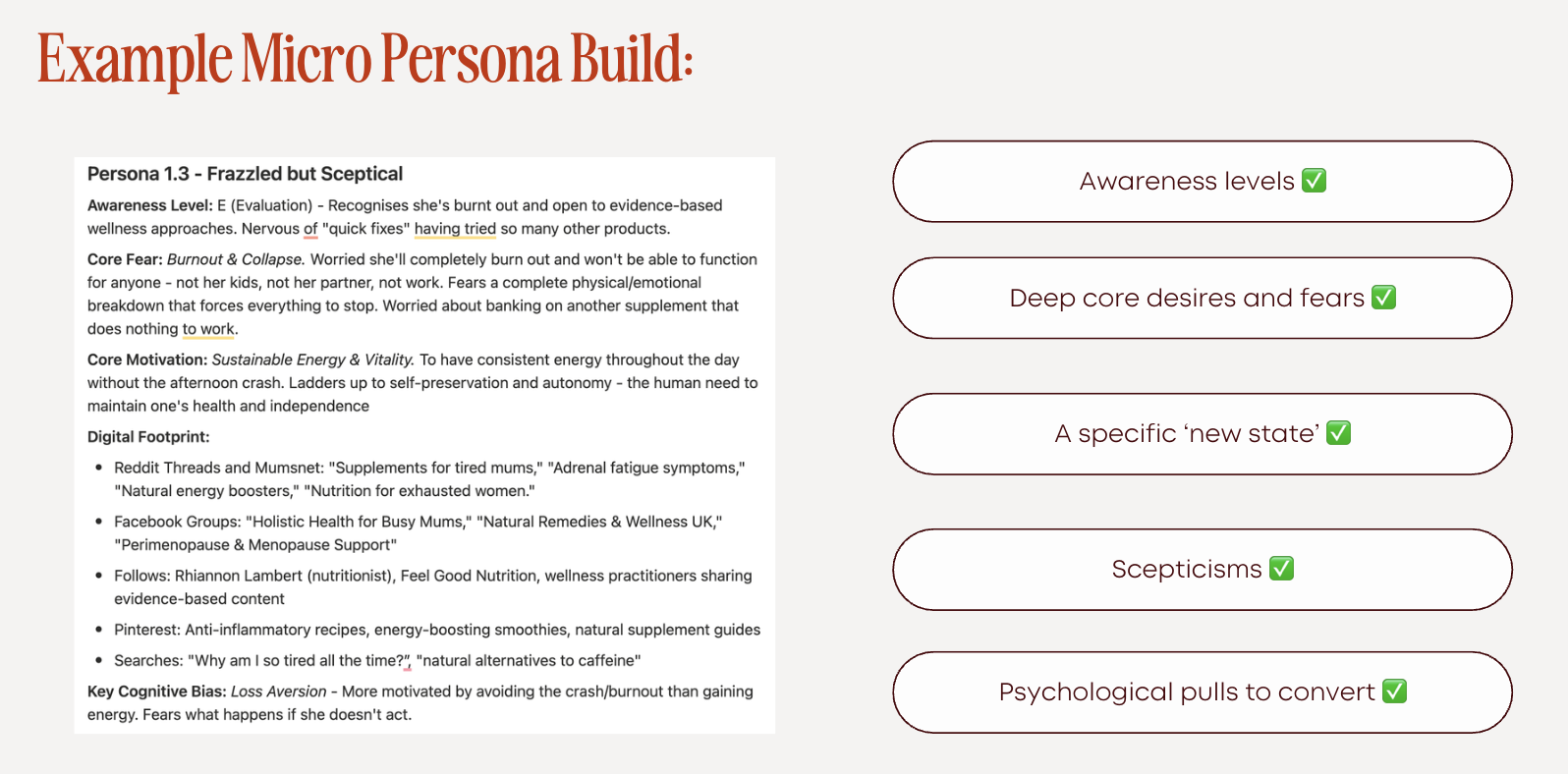
Evaluation awareness. Actively researching, nervous about quick fixes, open only to evidence-based approaches.
Core fear: complete burnout, that she'll stop being able to function for anyone who depends on her.
Digital footprint: Rhiannon Lambert, Mumsnet adrenal fatigue threads, Reddit.
The creative that converts her is authority-led, ingredient-transparent, mechanism-focused. The social proof ad that converts 1.1 makes her roll her eyes.
Same macro persona. Same product. Completely different signals required. If you're running one ad across all three, or ten ads all pitched at the same emotional place, you're signalling to no one specifically.
Twenty ads pitched at the same awareness state with the same cognitive bias aren't creative diversity. They signal to the same psychological territory. Andromeda groups them by entity ID similarity and delivers them to the same people, repeatedly.
Frequency builds, CPMs rise, incremental reach drops. It feels like a Meta ceiling. It's a signal ceiling.
Building for 1.1, 1.2, and 1.3 injects different signals. Andromeda can differentiate those assets and find people who match each profile. Reach expands because you're covering different psychological territory, not just producing more volume.
The strongest accounts also map the full chain: persona to creative angle to landing page to offer framing. A persona-congruent ad that lands on a generic homepage is a broken journey. If Persona 1.3 clicks through an evidence-based ad and arrives at lifestyle imagery and first-time user testimonials, you've lost her. The persona needs to survive the click.
Most accounts report by campaign type or funnel stage. If creative is the targeting mechanism and persona is the core creative variable, persona needs to be a performance variable.
Spend per persona. CAC per persona. New customer volume per persona. Which personas deserve scale capital? You can't answer that if persona doesn't show up in reporting. Right now most teams use it as a brief input and never see it again.
Your metrics can also tell you why creative is failing. High CTR with high bounce usually means awareness level mismatch. Low CTR with high impressions usually means the persona isn't matching the audience Andromeda is finding. High volume I was sceptical comments means you're not running enough creative that addresses prior failure. Each has a different fix, but you can only diagnose correctly if you know what persona the creative was built for.
If this article has described what you're seeing in your account, the Creative Intelligence Report is the logical next step.
It's a four-week strategic diagnostic we run at Hambi and Soar Group. We audit your full creative library against industry benchmarks, build research-backed micro-personas from competitor analysis, customer reviews, and social listening, and map every persona to specific messaging frameworks across each awareness level. You finish with a commercially ranked roadmap that tells you exactly what to build first and why.
This isn't a production package. We're not delivering a folder of assets. It's the strategic layer that makes everything you produce work harder, whether that's in-house or through your existing agency.
If your CAC is rising despite producing more creative, if your ads are burning out faster than they used to, or if you suspect you're only reaching a fraction of your addressable market, that's exactly the gap this was built to close.
Four weeks. Full diagnostic. A clear plan to scale spend without scaling CAC.
And if you're already working with a creative agency: this isn't a replacement for them. It's the strategic layer that makes everything they produce more effective. Think of it as the brief before the brief. Most of the brands we work with keep their existing production partners and see dramatically better results because the strategic direction is sharper.
Get in touch to find out more.

Something fundamental has changed about how people experience the internet.
The feed someone scrolls at 7am looks nothing like the one their partner sees. The ads that stop one person mid-scroll are invisible to another. Every platform is building a personalised reality for every individual user, shaped by years of behavioural data: what they watched, what they skipped, what they paused on, what they bought, what they quietly scrolled past three times before finally clicking.
Meta isn't finding audiences anymore. It's matching moments. A specific piece of creative, to a specific person, at a specific point in their decision-making journey.
Andromeda uses visual pattern matching to categorise creative. Ads that look similar, even with different hooks or copy, get grouped as one entity. GEM then optimises delivery of that entity toward proven converters, the same cluster of people, repeatedly. Lattice amplifies whatever patterns already exist in the account.
The result: Meta's AI gets very good at finding the people your current creative attracts, and completely ignores everyone else.
Which means the old model, one message, one audience, one funnel, is no longer a strategic choice. It's a structural disadvantage.
The brands winning right now are the ones feeding the algorithm enough distinct signals to find genuinely different people. Not ten versions of the same ad. Genuinely different stories, for genuinely different emotional states, built on genuinely different persona intelligence.
The brands still scaling spend without solving this are producing blind volume. More ads, same signal. The algorithm finds the same people faster, not new ones. Incremental reach doesn't come from more creative. It comes from more distinct personas giving the algorithm genuinely different territory to find.
Persona diversity means building creative for people who experience the same problem in fundamentally different ways, at different awareness levels, with different emotional blocks, and different cognitive biases. That's what generates new signals and what drives net-new customers.
This is a practical breakdown of how persona-led creative strategy actually works at the account level. I'll walk through the psychological frameworks we use at Hambi to build genuine signal diversity, show you exactly what a micro-persona looks like versus a macro one, and give you a real example of how the same product brief forks into three completely different ads for three completely different people.
By the end, you'll understand:
Time to read: approximately 8 minutes.
FTIR is sitting at 24%. CPMs have been climbing for six weeks. The creative team launched 30 new ads last month and the performance curve hasn't moved.
Someone suggests increasing the budget. Someone else wants to test new hooks. You run the numbers and nothing points to a clear answer, because the data is telling you the account is working, just not for anyone new.
This is the moment most brands misdiagnose.
They look at media spend, bid strategy, audience exclusions. They brief more creative. Some of them find a winning hook and ride it until frequency kills it, then start the cycle again.
What they don't look at is the persona layer. Specifically, whether the creative they're producing is genuinely signalling to different people, or just saying the same thing in different packaging.
Because Andromeda doesn't care how many ads you have in market. It cares how many distinct psychological territories those ads are covering. If the answer is one or two, you're not running 30 ads. You're running the same ad 30 times, paying more each week for the privilege of showing it to the same cluster of people.
That's not a Meta problem. That's a persona problem. And it starts long before the brief.
This comes up constantly in conversations with brands hitting frequency walls. In a recent episode of D2C Diaries, we spoke with a Meta insider about exactly this, what to do when frequency is rising and you need to unlock new audiences. Their advice cuts straight to it: stop thinking like a marketer and start thinking like a consumer. Not at the demographic level, but at the psychological and emotional level. The moment an ad feels like it knows you rather than targets you, everything changes.
At Hambi Media, we operate under a philosophy called soulmate theory. The idea is simple: there is a perfect creative for every single person. Not a good creative, the perfect one. The exact piece of content that speaks so directly to who they are, what they're feeling, and what they need right now, that it stops them mid-scroll and gets them to convert.
Our job is to make that creative. And the reason most brands aren't doing it is because they're starting in the wrong place: demographics.
Demographics can't get you to soulmate.
When we audit ad accounts, the persona document is almost always the first problem. It tends to say something like: Sarah, 30-45, stressed mum, overwhelmed with work and home life, values calm and wellbeing. The team briefs creative against it. Nothing breaks through. They assume it's a budget problem or a bidding problem.
It's almost always a signal problem. With Andromeda, the signals inside your ad are the brief to the algorithm and spend is the prompt. If the persona those signals are built on is shallow, you find the wrong people, or the same people, repeatedly, at rising CPMs.
A typical persona document gives you age range, personality description, interests, problem states. It looks complete. Through the lens of what Andromeda needs, there are important gaps.
There's no awareness level. Is she problem-aware but doesn't know solutions exist? Has she tried three products that didn't work? Is she actively comparing you against a competitor? Each is a fundamentally different person who needs a fundamentally different ad.
There are no core fears. Feels overwhelmed is a symptom. The fear that actually drives behaviour is more specific: the fear that her outbursts are permanently damaging her relationship with her children. That's a different brief, a different hook, a different emotional register.
There's no account of prior failures. If she's spent £200 on supplements that did nothing, she's in your funnel with her defences up. If your ad doesn't speak to that sceptic, it runs straight into her walls.
There's no cognitive bias mapping. Some users need social proof. Some need authority and clinical data. Some need identity reinforcement. Without knowing which lever applies, creative averages across all of them and averaging doesn't convert anyone well.
A persona without these layers gives Andromeda one psychological territory and asks it to run everywhere.
Stressed mum, 30-45 isn't a person. It's three or four psychologically distinct people who share a demographic profile. The shift from macro to micro is a shift from demographic description to psychological architecture.
Three questions separate out the mental states within a segment:
What different ways do people experience this problem? The stressed mum who hasn't identified stress management as the solution is experiencing her problem differently to the one who's been researching for six months.
What beliefs or emotional blocks exist? The woman who thinks she needs to be more organised has a different block to the one who's tried apps, breathing exercises, and three supplements that didn't work.
Why do some users convert instantly while others resist? This leads directly to cognitive bias, the mechanism that moves each sub-segment from consideration to action.
Most teams build personas on gut feeling. The ones that scale build them on signal: language and behaviour their customers are already producing.
Customer reviews. Export your last 500 and look for recurring phrases describing a change in life state. If 20% of reviewers mention using a commuter backpack as a baby changing bag because of the easy-wipe lining, you've found a micro-persona your demographic brief missed entirely. Use that language verbatim, don't paraphrase it.
Comments and organic social. Look for the yes, but comments on your top organic posts. Looks great, but is it actually sweat-proof for heavy cardio? That's a persona. Your next brief: to the person asking if this is sweat-proof for heavy cardio, watch this. A doubt becomes a sceptic brief.
Competitor ad libraries. Look for the personas your competitors aren't running. If everyone briefs the same creator archetype, there's likely an underserved audience node with lower CPMs waiting for whoever gets there first.
Awareness level (TEEP): Trigger, Exploration, Evaluation, Purchase. This determines hook strategy, education depth, proof requirements, and CTA intensity. Speaking to someone in Evaluation mode as if they've just discovered the problem is probably the single biggest driver of wasted spend.
Core fears and desires: Wants less stress is not a core desire. Wants to be emotionally present during the limited years her kids still want to hug her is, and it writes a completely different ad.
Cognitive bias: Which psychological shortcut is this person most likely to respond to? Social proof for one persona, authority and clinical data for another, identity reinforcement for a third.
Creative consumption. The creative that converts her needs to look and feel like something she already chooses to watch and avoid the format she scrolls past because it looks like an ad.
To translate this into an actual creator brief, you also need:
The Authentic Archetype: a specific, named role a creator can inhabit. The Overwhelmed First-Time Mum. The more specific, the more precisely Andromeda categorises it.
The Aesthetic Environment: what the background looks like. A minimalist kitchen signals a different audience than a cluttered family home. The scenery is part of the signal.
The Internal Monologue: the exact vocabulary this person uses, pulled from reviews and Reddit threads. The thought she has right before she searches for a solution. Use her words.
The Anti-Persona: what this persona is actively rejecting. Calling that out in the creative is often exactly what makes her stop scrolling.
Trigger awareness. She's struggling but hasn't identified stress management as the solution. She thinks she just needs to try harder.
Core fear: being seen as a bad mum who can't keep it together.
Digital footprint: Mrs Hinch, Steph Douglas, productivity influencers.
The creative that converts her is peer-led social proof. A clinical ad on cortisol mechanisms does nothing.
Exploration awareness. She knows she needs help but is overwhelmed by options.
Core fear: her irritability is permanently damaging her relationship with her children.
Digital footprint: Dr. Becky Kennedy, The Motherkind podcast, Mindful Mamas Facebook groups.
The creative that converts her is emotionally resonant, identity-led. Authority doesn't move her.
Evaluation awareness. Actively researching, nervous about quick fixes, open only to evidence-based approaches.
Core fear: complete burnout, that she'll stop being able to function for anyone who depends on her.
Digital footprint: Rhiannon Lambert, Mumsnet adrenal fatigue threads, Reddit.
The creative that converts her is authority-led, ingredient-transparent, mechanism-focused. The social proof ad that converts 1.1 makes her roll her eyes.
Same macro persona. Same product. Completely different signals required. If you're running one ad across all three, or ten ads all pitched at the same emotional place, you're signalling to no one specifically.
Twenty ads pitched at the same awareness state with the same cognitive bias aren't creative diversity. They signal to the same psychological territory. Andromeda groups them by entity ID similarity and delivers them to the same people, repeatedly.
Frequency builds, CPMs rise, incremental reach drops. It feels like a Meta ceiling. It's a signal ceiling.
Building for 1.1, 1.2, and 1.3 injects different signals. Andromeda can differentiate those assets and find people who match each profile. Reach expands because you're covering different psychological territory, not just producing more volume.
The strongest accounts also map the full chain: persona to creative angle to landing page to offer framing. A persona-congruent ad that lands on a generic homepage is a broken journey. If Persona 1.3 clicks through an evidence-based ad and arrives at lifestyle imagery and first-time user testimonials, you've lost her. The persona needs to survive the click.
Most accounts report by campaign type or funnel stage. If creative is the targeting mechanism and persona is the core creative variable, persona needs to be a performance variable.
Spend per persona. CAC per persona. New customer volume per persona. Which personas deserve scale capital? You can't answer that if persona doesn't show up in reporting. Right now most teams use it as a brief input and never see it again.
Your metrics can also tell you why creative is failing. High CTR with high bounce usually means awareness level mismatch. Low CTR with high impressions usually means the persona isn't matching the audience Andromeda is finding. High volume I was sceptical comments means you're not running enough creative that addresses prior failure. Each has a different fix, but you can only diagnose correctly if you know what persona the creative was built for.
If this article has described what you're seeing in your account, the Creative Intelligence Report is the logical next step.
It's a four-week strategic diagnostic we run at Hambi and Soar Group. We audit your full creative library against industry benchmarks, build research-backed micro-personas from competitor analysis, customer reviews, and social listening, and map every persona to specific messaging frameworks across each awareness level. You finish with a commercially ranked roadmap that tells you exactly what to build first and why.
This isn't a production package. We're not delivering a folder of assets. It's the strategic layer that makes everything you produce work harder, whether that's in-house or through your existing agency.
If your CAC is rising despite producing more creative, if your ads are burning out faster than they used to, or if you suspect you're only reaching a fraction of your addressable market, that's exactly the gap this was built to close.
Four weeks. Full diagnostic. A clear plan to scale spend without scaling CAC.
And if you're already working with a creative agency: this isn't a replacement for them. It's the strategic layer that makes everything they produce more effective. Think of it as the brief before the brief. Most of the brands we work with keep their existing production partners and see dramatically better results because the strategic direction is sharper.
Get in touch to find out more.


.svg)