Every consumer now experiences a different brand. As outlined in our 2026 D2C Playbook: The New Rules of Meta, TikTok, AI & Performance Creative - every consumer now lives inside a personal algorithmic bubble.This marks a huge turning point for ecom: every consumer now experiences a feed, a search result, and a shopping journey that is uniquely their own. Platforms like Meta, Google, and TikTok are no longer just matching ads to audiences, they’re delivering hyper-personalised experiences based on micro-behaviours, emotional signals, and past engagement.
This is largely due to Meta’s new Andromeda engine which has replaced tidy, rule-based targeting with a hungry, probabilistic system that lives on fresh data and limitless creative options. It can trial 5,000 ads a week, not 50, which means the brands that win are the ones that feed it a steady diet of diverse, insight-driven assets - and they do it fast.
Find out more about Meta Andromeda, and how to feed the beast, here.
Different feeds, different creators, different hooks, and different problems being solved. The concept that one message, one audience, and one funnel can drive meaningful scale is now outdated.
Kind Patches is a strong example of what it looks like when a brand fully understands this shift, and can be used as a blueprint for how to build a brand around personas and outcomes. This blog will dive into some core pillars of this strategy, and you can download the full breakdown for free here.
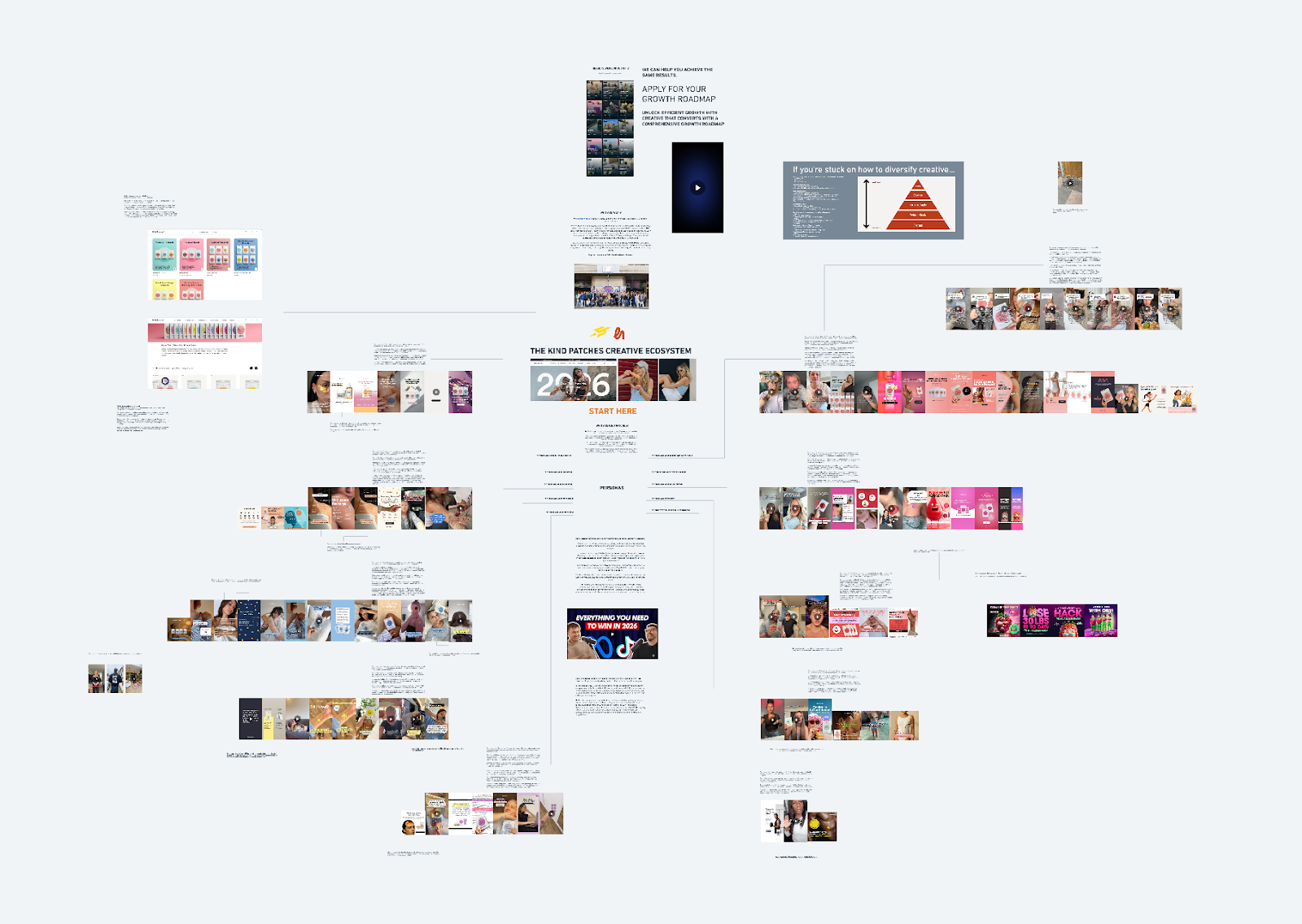
Kind Patches is a great example of solution-orientated positioning, and leaning into storytelling and emotional triggers. For example, instead of asking consumers to understand what a patch is or how it works, they start with how someone feels e.g. tired, stressed, bloated.
Each of these states becomes its own seperate entry point into the brand. Rather than over-simplifying wellness into a single narrative, Kind Patches expands it into multiple, clearly defined use cases - sleep, stress, energy, focus, hormones, metabolism, libido, travel recovery, performance - the list is endless!
This framing allows the brand to speak to many different versions of the same customer, often at different moments in their life or week, without diluting its identity.
One of the most telling aspects of the Kind Patches approach is how consistently they reuse core ideas, and how differently those ideas are expressed depending on who they’re speaking to.
Weight loss is a good example. Rather than anchoring everything to a single transformation narrative, the brand reframes the same core promise through multiple emotional lenses. For one person, the problem is constant snacking. For another, it’s guilt around food. For someone else, it’s fatigue from dieting, or frustration with the cost and complexity of GLP-1 injections. The solution remains the same, but the story changes.
This is where creative scale actually comes from. Not from endlessly inventing new concepts, but from understanding how one concept can feel personal to many different people. We think of it like a hierarchy.

Our co-founder, Olly Hudson, recently explained this concept over on LinkedIn:
At the base are the big creative swings, at the top, the small refinements.
When you’re launching:
→ Launch brand new concepts from scratch.
→ Test messaging within those fresh ads, don’t just swap copy into old visuals.
The goal: identify the message, persona, format combo that resonates most.
It keeps learnings clean and avoids grouping penalties.
(Even if variations get grouped under the same Entity ID, a winner will emerge).
When you’re optimising:
Got a winner? Remix it.
→ Change the format or the vehicle
→ Update the hook so it looks instantly different
→ Translate the story to a new style (e.g. founder VSL → third-person VO)
Here’s the hierarchy we use inside every high-growth account:
1. Format
Static / UGC / High-Production
→ Use when you're plateauing or need fresh signals.
2. Vehicle
Founder story / Green-screen / Testimonial / Listicle / Product demo
→ Use to scale a proven message across new personas.
3. Persona
Gen Z female → 40+ mum / Creator → Founder
→ Use to expand TAM or unlock overlooked pockets.
4. Hook
Zoomed-in face / Problem-statement / Unboxing / B-roll
→ Use to ensure Meta sees your ad as net-new.
5. Messaging
Script tweaks / CTA variants
→ Use once a concept is already converting.
If your creative system isn’t built around this hierarchy, you won’t scale in 2026.
Kind Patches feeds Andromeda what it needs:
Multiple creatives solving the same problem in different emotional ways
The same concept reframed for different micro-personas
High creative volume without message fragmentation
Rather than relying on interest targeting to find audiences, creative does the targeting. The algorithm matches messages to people based on behaviour and intent, not assumptions.
This is how incremental reach is unlocked in 2025 - and why Kind Patches can support thousands of live ads simultaneously without performance collapsing.
This directly mirrors what we discussed in the DTC Diaries 2026 Playbook episode:
Kind Patches doesn’t rely on heavy audience targeting to find customers. Instead, creative does the work - a fantastic demonstration of differentiation within the factors outlined in our hierarchy.
This approach aligns naturally with how modern ad systems operate. Meta’s Andromeda, in particular, is designed to reward breadth, variety, and signal richness. By feeding the beast with many emotionally distinct but strategically aligned ads, Kind Patches increases the chances of incremental reach and improving NC-ROAS.
Let’s talk beyond the ads.
Where many brands lose momentum is after the click. Kind Patches doesn’t.
The website feels like a continuation of the ad experience. Products are grouped around goals, seasonal moments like the January Reset reflect genuine shifts in consumer mindset, and someone arriving in a “new year, new habits” frame is met with everything they need.
The result is a journey that feels intuitive. Users don’t need to decode the range.
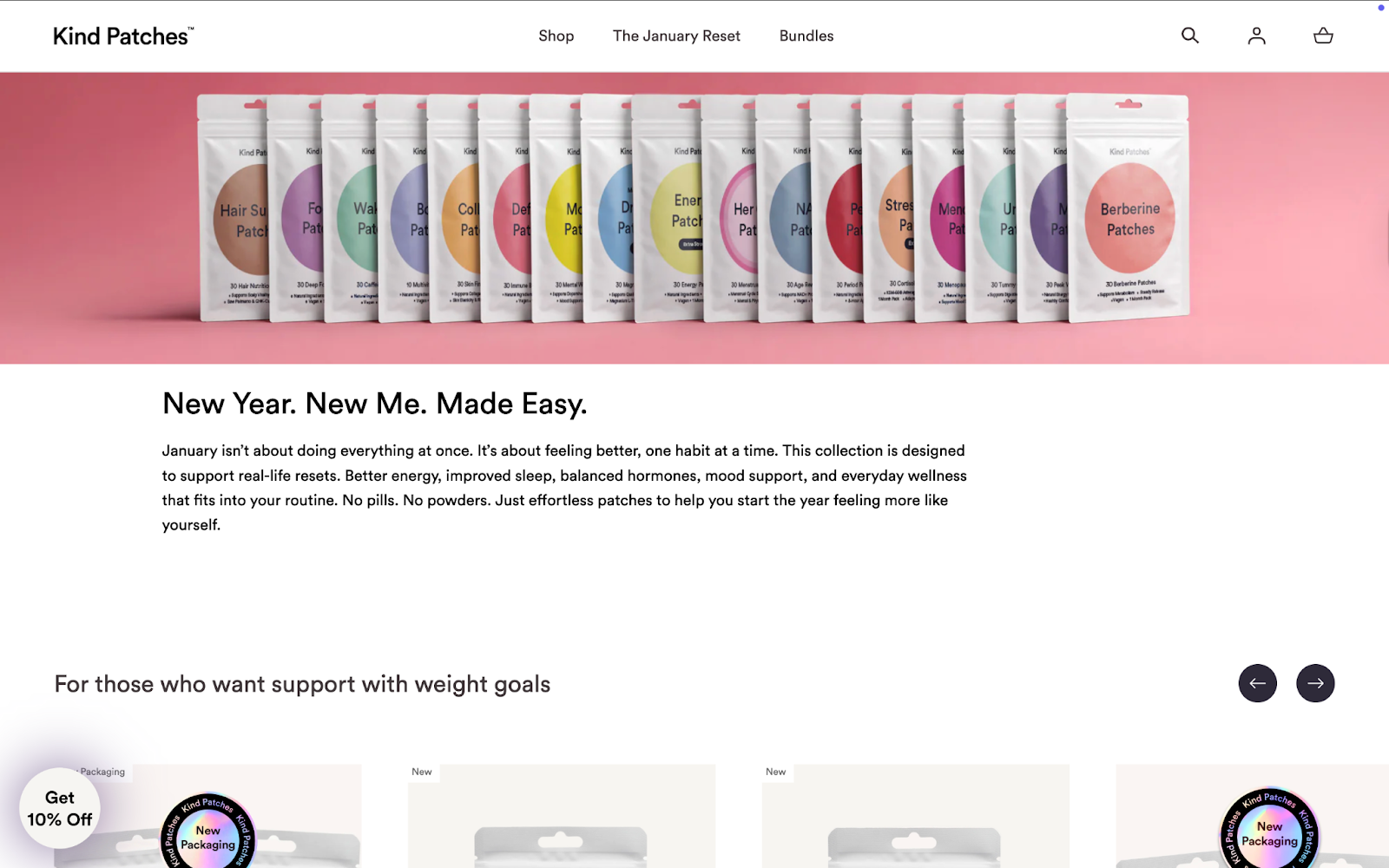
The same philosophy shows up in how Kind Patches approaches bundling. Instead of pushing volume for the sake of AOV, bundles are positioned as curated solutions. They answer an unspoken question many consumers have but rarely articulate: “What actually works together for me?”
Whether it’s beauty, metabolism, stress and energy, or a full reset, each bundle is framed as support for a specific outcome or moment in time. That framing builds confidence and reduces decision fatigue, while also reinforcing the idea that the brand understands the customer’s problem in context, not in isolation.
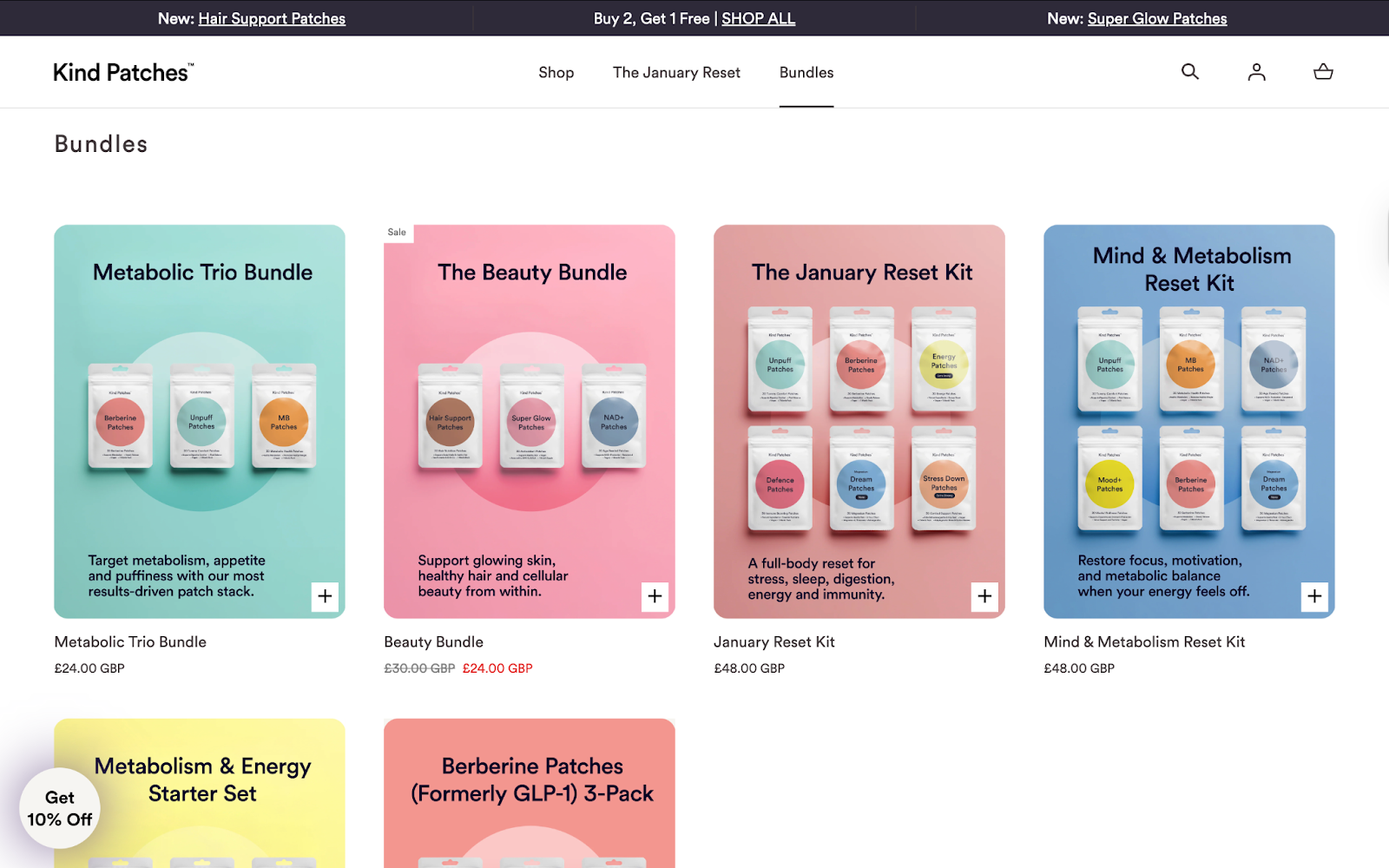
This article is a high-level look at the system. The full Kind Patches Breakdown goes deeper into how persona-led thinking shows up across creative, paid media, website structure, and bundles, and what other brands can learn from it.
If you’re responsible for growth, creative, or paid media, this breakdown gives you clarity most teams won’t have until they feel performance plateau.
Download instantly for free here.

Every consumer now experiences a different brand. As outlined in our 2026 D2C Playbook: The New Rules of Meta, TikTok, AI & Performance Creative - every consumer now lives inside a personal algorithmic bubble.This marks a huge turning point for ecom: every consumer now experiences a feed, a search result, and a shopping journey that is uniquely their own. Platforms like Meta, Google, and TikTok are no longer just matching ads to audiences, they’re delivering hyper-personalised experiences based on micro-behaviours, emotional signals, and past engagement.
This is largely due to Meta’s new Andromeda engine which has replaced tidy, rule-based targeting with a hungry, probabilistic system that lives on fresh data and limitless creative options. It can trial 5,000 ads a week, not 50, which means the brands that win are the ones that feed it a steady diet of diverse, insight-driven assets - and they do it fast.
Find out more about Meta Andromeda, and how to feed the beast, here.
Different feeds, different creators, different hooks, and different problems being solved. The concept that one message, one audience, and one funnel can drive meaningful scale is now outdated.
Kind Patches is a strong example of what it looks like when a brand fully understands this shift, and can be used as a blueprint for how to build a brand around personas and outcomes. This blog will dive into some core pillars of this strategy, and you can download the full breakdown for free here.
Kind Patches is a great example of solution-orientated positioning, and leaning into storytelling and emotional triggers. For example, instead of asking consumers to understand what a patch is or how it works, they start with how someone feels e.g. tired, stressed, bloated.
Each of these states becomes its own seperate entry point into the brand. Rather than over-simplifying wellness into a single narrative, Kind Patches expands it into multiple, clearly defined use cases - sleep, stress, energy, focus, hormones, metabolism, libido, travel recovery, performance - the list is endless!
This framing allows the brand to speak to many different versions of the same customer, often at different moments in their life or week, without diluting its identity.
One of the most telling aspects of the Kind Patches approach is how consistently they reuse core ideas, and how differently those ideas are expressed depending on who they’re speaking to.
Weight loss is a good example. Rather than anchoring everything to a single transformation narrative, the brand reframes the same core promise through multiple emotional lenses. For one person, the problem is constant snacking. For another, it’s guilt around food. For someone else, it’s fatigue from dieting, or frustration with the cost and complexity of GLP-1 injections. The solution remains the same, but the story changes.
This is where creative scale actually comes from. Not from endlessly inventing new concepts, but from understanding how one concept can feel personal to many different people. We think of it like a hierarchy.
Our co-founder, Olly Hudson, recently explained this concept over on LinkedIn:
At the base are the big creative swings, at the top, the small refinements.
When you’re launching:
→ Launch brand new concepts from scratch.
→ Test messaging within those fresh ads, don’t just swap copy into old visuals.
The goal: identify the message, persona, format combo that resonates most.
It keeps learnings clean and avoids grouping penalties.
(Even if variations get grouped under the same Entity ID, a winner will emerge).
When you’re optimising:
Got a winner? Remix it.
→ Change the format or the vehicle
→ Update the hook so it looks instantly different
→ Translate the story to a new style (e.g. founder VSL → third-person VO)
Here’s the hierarchy we use inside every high-growth account:
1. Format
Static / UGC / High-Production
→ Use when you're plateauing or need fresh signals.
2. Vehicle
Founder story / Green-screen / Testimonial / Listicle / Product demo
→ Use to scale a proven message across new personas.
3. Persona
Gen Z female → 40+ mum / Creator → Founder
→ Use to expand TAM or unlock overlooked pockets.
4. Hook
Zoomed-in face / Problem-statement / Unboxing / B-roll
→ Use to ensure Meta sees your ad as net-new.
5. Messaging
Script tweaks / CTA variants
→ Use once a concept is already converting.
If your creative system isn’t built around this hierarchy, you won’t scale in 2026.
Kind Patches feeds Andromeda what it needs:
Multiple creatives solving the same problem in different emotional ways
The same concept reframed for different micro-personas
High creative volume without message fragmentation
Rather than relying on interest targeting to find audiences, creative does the targeting. The algorithm matches messages to people based on behaviour and intent, not assumptions.
This is how incremental reach is unlocked in 2025 - and why Kind Patches can support thousands of live ads simultaneously without performance collapsing.
This directly mirrors what we discussed in the DTC Diaries 2026 Playbook episode:
Kind Patches doesn’t rely on heavy audience targeting to find customers. Instead, creative does the work - a fantastic demonstration of differentiation within the factors outlined in our hierarchy.
This approach aligns naturally with how modern ad systems operate. Meta’s Andromeda, in particular, is designed to reward breadth, variety, and signal richness. By feeding the beast with many emotionally distinct but strategically aligned ads, Kind Patches increases the chances of incremental reach and improving NC-ROAS.
Let’s talk beyond the ads.
Where many brands lose momentum is after the click. Kind Patches doesn’t.
The website feels like a continuation of the ad experience. Products are grouped around goals, seasonal moments like the January Reset reflect genuine shifts in consumer mindset, and someone arriving in a “new year, new habits” frame is met with everything they need.
The result is a journey that feels intuitive. Users don’t need to decode the range.
The same philosophy shows up in how Kind Patches approaches bundling. Instead of pushing volume for the sake of AOV, bundles are positioned as curated solutions. They answer an unspoken question many consumers have but rarely articulate: “What actually works together for me?”
Whether it’s beauty, metabolism, stress and energy, or a full reset, each bundle is framed as support for a specific outcome or moment in time. That framing builds confidence and reduces decision fatigue, while also reinforcing the idea that the brand understands the customer’s problem in context, not in isolation.
This article is a high-level look at the system. The full Kind Patches Breakdown goes deeper into how persona-led thinking shows up across creative, paid media, website structure, and bundles, and what other brands can learn from it.
If you’re responsible for growth, creative, or paid media, this breakdown gives you clarity most teams won’t have until they feel performance plateau.
Download instantly for free here.


.svg)


.png)