
We've already covered how Meta’s Andromeda update has redefined how brands reach their audiences. It's a huge update, with huge implications. And one of the biggest differences this BFCM comes down to how much detail your personas actually need.
A key thing to remember: two shoppers can share the exact same age, gender, and postcode and still have completely different fears, motivators, and beliefs driving the purchase.
The same BFCM ad won't convert both of them (it might not even stop both of them scrolling).
⭐You need to go a layer deeper than who they are, into why they buy.
So before you touch any research tool, spend, or offer, you need a framework for what "deeper" actually means.
Cue the three-layer persona taxonomy…
Before you research anything, think in three layers:
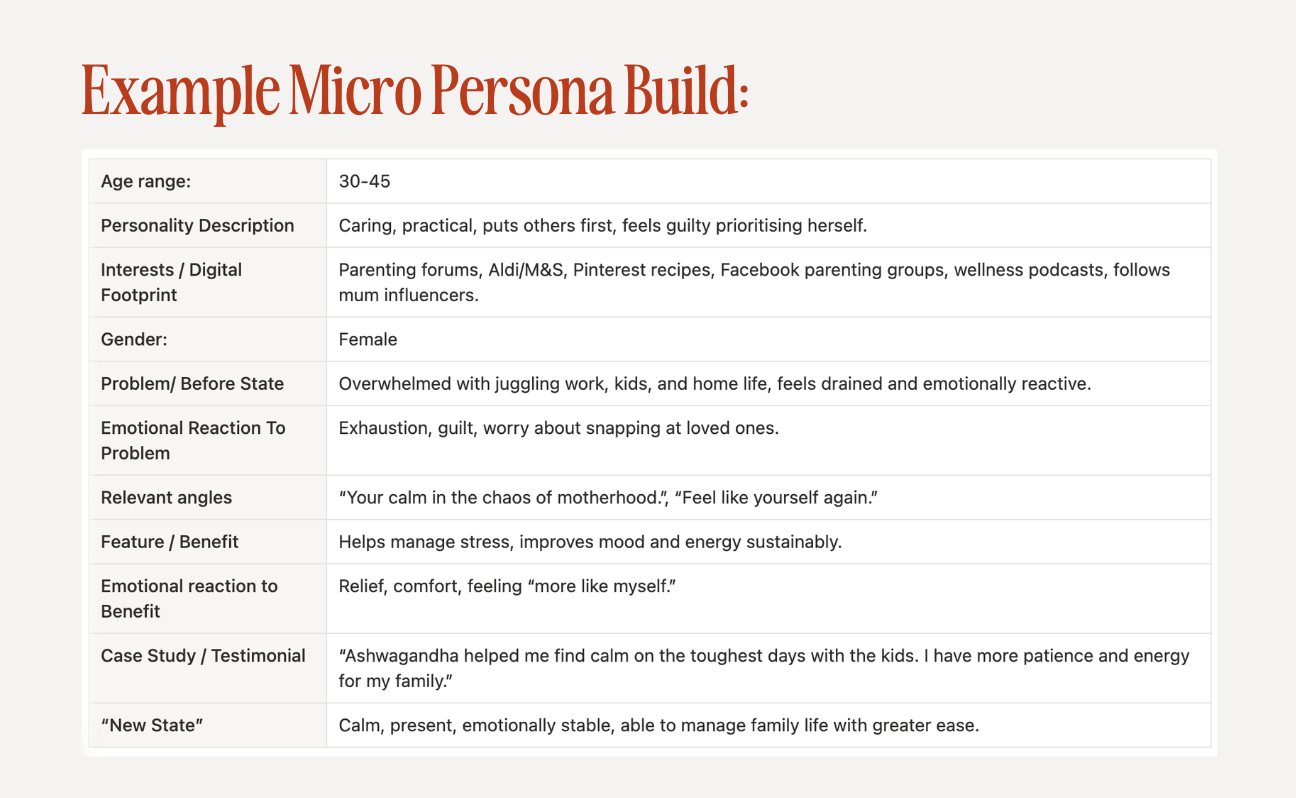
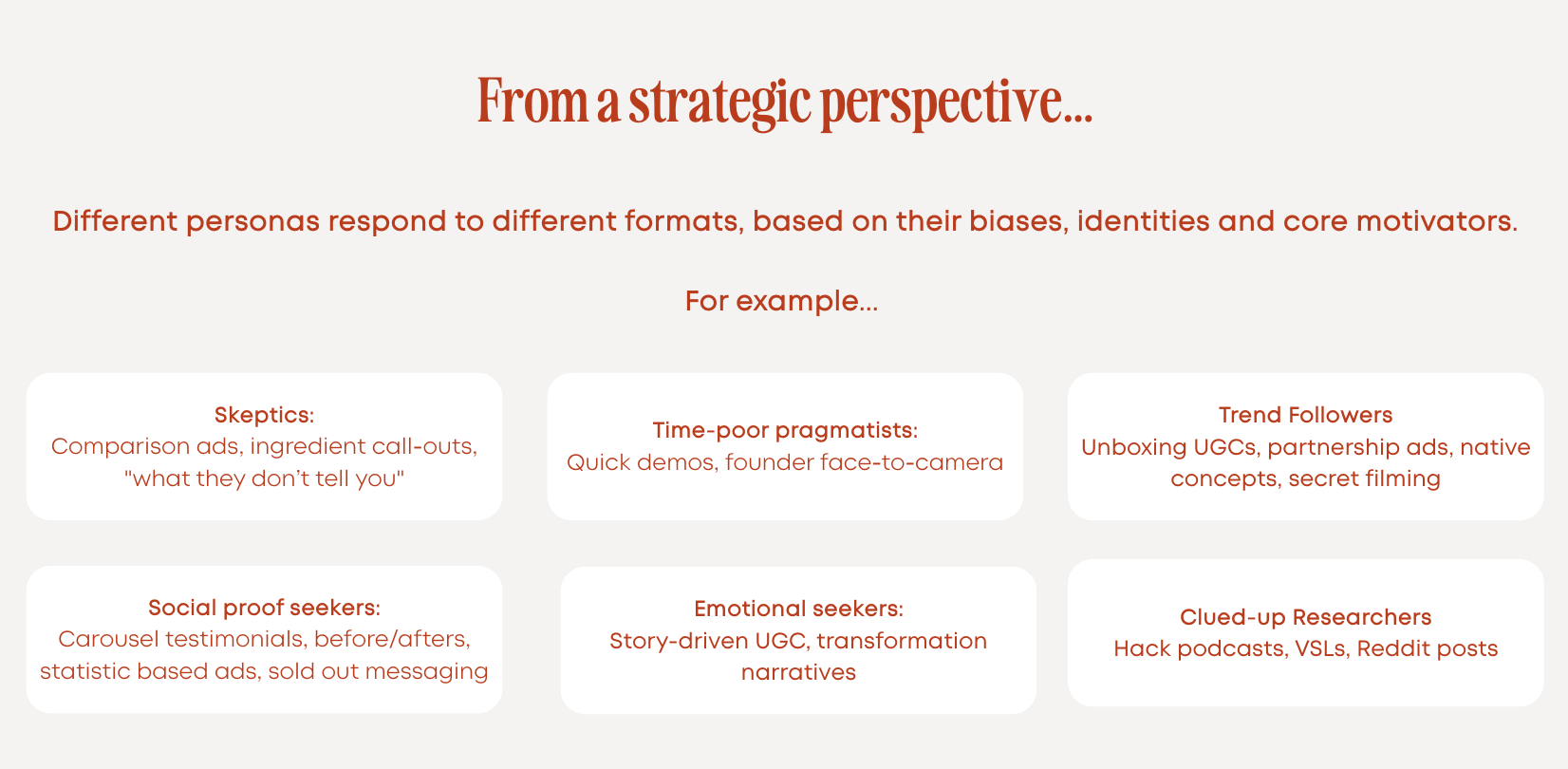
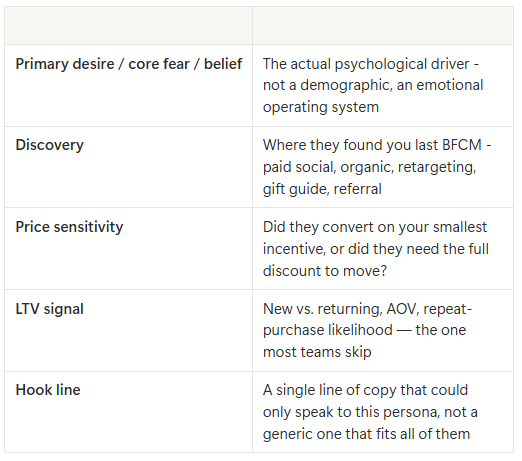
Let’s go a little deeper into what a BFCM micro-persona may need…
Key elements to consider during BFCM:
Example micro-personas, built this way:
Every one of these should be a distinct creative signal. That distinction is what separates brands scaling their ad accounts.
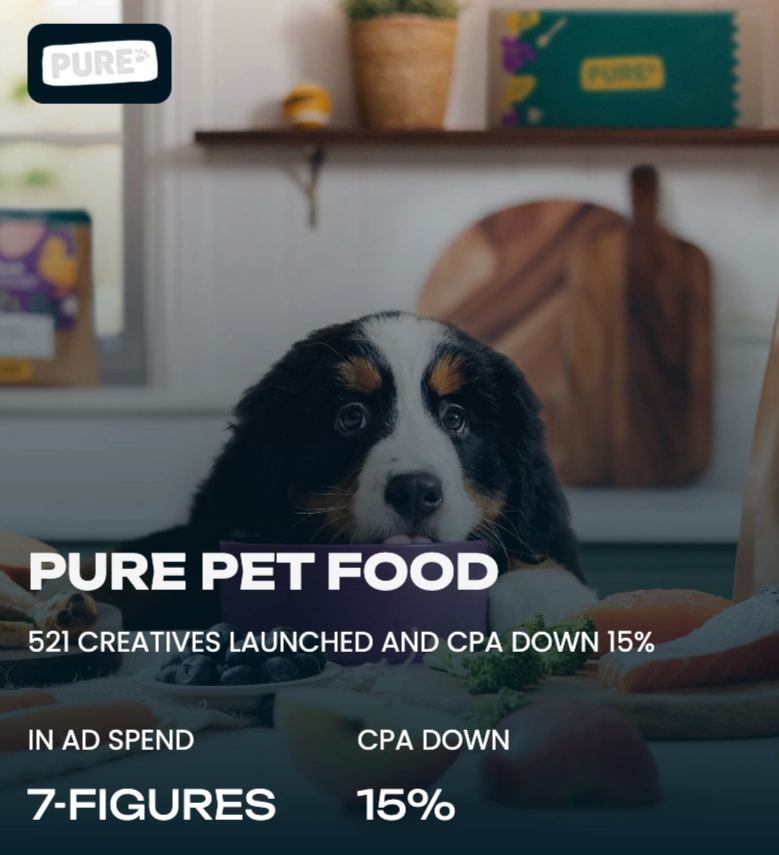
We've seen it play out directly. With Pure Pet Food, the fix was the right micro-personas, with creative that was distinct and targeted. Two personas anchored the whole strategy: the Research-Led Realist, sceptical and looking for proof, versus the Worried Wellness Seeker, needing reassurance, not a pitch. That split alone helped drive CPA down 15% across 521 assets - without pulling back on volume.
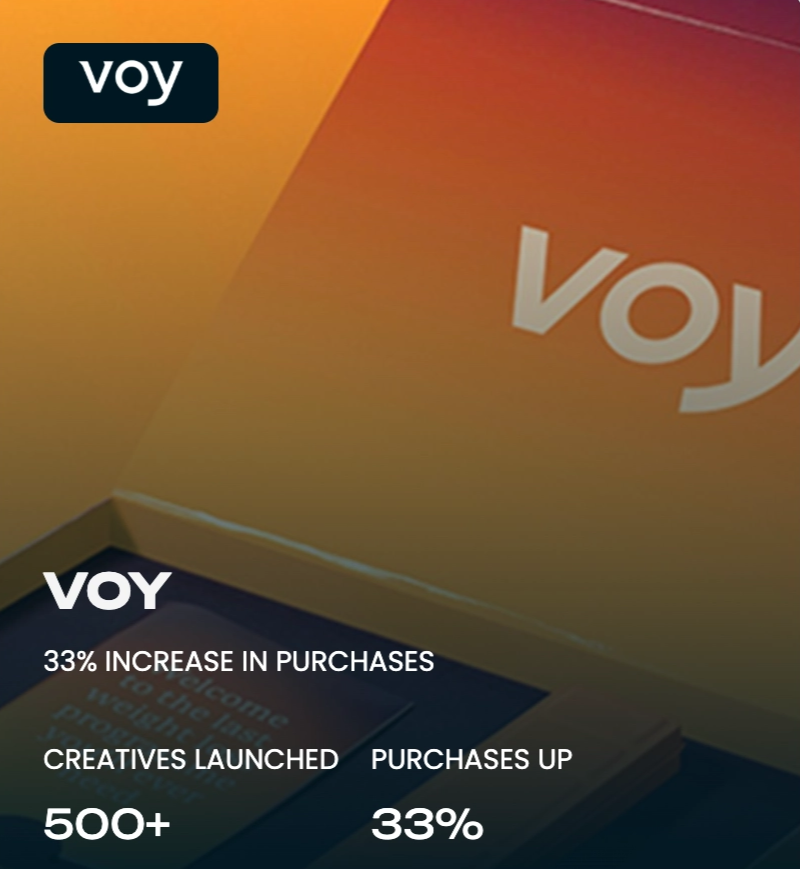
Same story with Voy: the unlock was building genuine personas e.g. the "dad persona" - targeting real hesitations men actually had. Result: 500+ assets, 71% increase in outbound CTR, 33% increase in purchases.
Of course, all of this only works if the personas are built on something real…
Guessing your way to these layers is the ceiling most brands hit.
Here's how we build them on real signal instead.
Why we use this: Consumer behaviour moves fast, and the best-performing BFCM angles are sitting in real-time, real-world conversations happening right now. And lets be honest, X is the place to go for very candid opinions.
What it's unlocked for us: Grok once surfaced a stat that women going through menopause are 30% more likely to suffer from bloating. It pulled the original study, paired it with live Twitter discussion, and extracted the emotional language people were actually using. We built an ad off that single finding. Two weeks later: top performer in the account, £12 CAC, £40k+ pipeline.
👌 Steal this prompt - swap in your category (gifting, gut health, skincare, whatever fits your BFCM angle):
I want to uncover new evidence-based messaging angles for paid marketing.
Search the latest conversations on twitter (X) to identify **psychological, emotional, or behavioural pain points** related to:
🔍 Topic: [Insert topic]
Please return findings that could inform **marketing messaging**, especially those that:
- Reveal surprising or underutilised consumer pain points or desires
- Offer strong psychological or emotional insight into consumer behaviour
- Can be translated into high-performing **problem/solution messaging**
- Are published **within the last 1-2 years** (recency matters)
🧠 For each relevant finding, return the following structured format within a table:
---
1. **Tweet post & Link**
2a. **Key Finding** (verbatim from the study)
2b. **Statistics** (any striking or useful quantitative data if applicable)
3. **Layman's Summary** — what this means for a general audience
4. **Emotional Language** — any emotional/sensory words used in the study (quotes if possible)
5. **Pain Point or Problem it Addresses**
6. **Funnel Stage Mapping** — classify the insight as:
- **Unaware** — Consumer doesn't know there's a problem (e.g. filtered shower heads, indoor air quality)
- **Problem Aware** — Emotion-heavy, story-driven pain points (e.g. burnout, gut issues, financial stress)
- **Solution Aware** — They know the problem exists and there are solutions, but need to know why your product is different (USP, FAB, "us vs them" messaging)
- **Product Aware** — Know your brand, but not yet convinced — objection-handling, proof, trust
7. **Best-Fit Demographic** — age, gender, lifestyle, psychographic
8. **Suggested Messaging Hook or Ad Angle** *(optional)*
9. **Why This Matters for Paid Marketing** *(optional)*
---
✅ **Requirements**:
- Return up to **10** insights total
- Only include findings with **clear emotional, psychological, or behavioural implications**
- Prioritise posts with impact on **consumer perception, motivation, or decision-making**
- Use only **real posts on twitter (X) that have been posted by real users**
---
OPTIONAL: If available, also include:
- ⚡️ Surprising or friction-causing insights
- 📈 Whether the paper is trending (fast-growing citations)
- 🎯 Recommended **funnel stage fit** (based on tone and finding)
Use this when your BFCM angles are starting to feel repetitive, or you need to validate a hunch before you brief creative off it.
Reddit's AI is another shortcut for understanding what people actually think. It pulls patterns from the honest, unfiltered conversations happening across the platform: what people love, what annoys them, what they're comparing, what they're actively shopping for right now.
👉 reddit.com/answers is the fastest way in. Use it to check a persona before BFCM briefs go out - if the language your team is using doesn't match what's actually showing up in these threads, revisit them.
You're already sitting on an absolute goldmine: last BFCM's customer reviews. These firsthand accounts are the most valuable insight into your product and your audience, and most brands never touch them.
AI-Assisted Social Listening in 3 Steps:
You want the AI to give you a report on key points around Product (value propositions, unique features and benefits) and Customer (pain points, desired outcomes, purchase prompts, misconceptions, failed solutions, objections).
👌 Steal this prompt:
Now, I will present a collection of reviews for [BRAND]'s [PRODUCT] available at [PRODUCT URL]. Please take a moment to read through them carefully, and once you're done, I will proceed with a series of questions based on these reviews.
Here are the reviews:
[REVIEWS]
Let's analyse the reviews to identify the most common customer perspectives and insights related to the product. We will focus on the following categories, each accompanied by an appropriate emoji for clarity:
Product:
1. Main Unique Value propositions (What are the main reasons why people purchased this product? (benefits/advantages))
2. Unique Features/Benefits (What are the unique selling points this product has over its' competitors?)
Customer:
Customer Pain Points - What are the most significant or frequently mentioned challenges or issues that customers sought to address or alleviate using this product?
Customer Desired Outcomes - What are the most commonly expressed goals or desired results that customers expected or hoped to achieve when purchasing this product?
Customer Purchase Prompts - What specific events or triggers led customers to consider purchasing this product? What influenced their decision to explore or invest in it?
Customer Misconceptions - What misconceptions or misunderstandings did customers have about the product or brand before their experience with it? What false beliefs or assumptions have they come to realise are not true?
Customer Failed Solutions - What alternative solutions or approaches have customers previously attempted but found ineffective or unsatisfactory in addressing their needs? What previous methods or products have failed to meet their expectations?
Customer Objections - Why did customers initially doubt or question whether this product would work for them? What concerns or reservations did they have? What specific aspects or perceptions about the product caused hesitation or apprehension before making a purchase?
Please use Markdown formatting to ensure the content is presented in an organised and visually appealing manner.
(For this to work effectively, you must provide the AI tool with at least 50 of both positive and negative reviews.)
Use the resulting report to tag review volume against each of your micro-personas - giving you a data-backed steer on which persona is actually biggest, and what language they use.
Once your personas are rebuilt on real evidence, the next job is putting them to work, starting with the data you're already sitting on from last year.
One mistake we see teams making, that we don’t want you to make: pulling "top ads by revenue" and calling it their BFCM research. That tells you what happened. It doesn't tell you who made it happen - and without that, you're optimising blind for this year.
Instead:
Knowing who converted last year is only half the picture. The other half is knowing how each of those personas will respond to this year's offer before you commit spend to it.
Don't default to re-running what worked last year across the board. Brands operating at a top level are:
The brands winning this BFCM are using evidence-based insight, real consumer language, and AI-assisted research to fuel a creative strategy that actually scales - and the results speak for themselves: Pure Pet Food drove CPA down 15% across 521 assets, Voy grew purchases 33% off a persona built from real hesitations, and TRIP scaled spend 206% during their biggest campaign of the year, all while efficiency held or improved.
If you want us to help you:
👉 Build data-backed personas for BFCM
👉 Unlock new angles grounded in real buyer psychology
👉 Translate research into high-performing ads on Meta & TikTok

We've already covered how Meta’s Andromeda update has redefined how brands reach their audiences. It's a huge update, with huge implications. And one of the biggest differences this BFCM comes down to how much detail your personas actually need.
A key thing to remember: two shoppers can share the exact same age, gender, and postcode and still have completely different fears, motivators, and beliefs driving the purchase.
The same BFCM ad won't convert both of them (it might not even stop both of them scrolling).
⭐You need to go a layer deeper than who they are, into why they buy.
So before you touch any research tool, spend, or offer, you need a framework for what "deeper" actually means.
Cue the three-layer persona taxonomy…
Before you research anything, think in three layers:
Let’s go a little deeper into what a BFCM micro-persona may need…
Key elements to consider during BFCM:
Example micro-personas, built this way:
Every one of these should be a distinct creative signal. That distinction is what separates brands scaling their ad accounts.
We've seen it play out directly. With Pure Pet Food, the fix was the right micro-personas, with creative that was distinct and targeted. Two personas anchored the whole strategy: the Research-Led Realist, sceptical and looking for proof, versus the Worried Wellness Seeker, needing reassurance, not a pitch. That split alone helped drive CPA down 15% across 521 assets - without pulling back on volume.
Same story with Voy: the unlock was building genuine personas e.g. the "dad persona" - targeting real hesitations men actually had. Result: 500+ assets, 71% increase in outbound CTR, 33% increase in purchases.
Of course, all of this only works if the personas are built on something real…
Guessing your way to these layers is the ceiling most brands hit.
Here's how we build them on real signal instead.
Why we use this: Consumer behaviour moves fast, and the best-performing BFCM angles are sitting in real-time, real-world conversations happening right now. And lets be honest, X is the place to go for very candid opinions.
What it's unlocked for us: Grok once surfaced a stat that women going through menopause are 30% more likely to suffer from bloating. It pulled the original study, paired it with live Twitter discussion, and extracted the emotional language people were actually using. We built an ad off that single finding. Two weeks later: top performer in the account, £12 CAC, £40k+ pipeline.
👌 Steal this prompt - swap in your category (gifting, gut health, skincare, whatever fits your BFCM angle):
I want to uncover new evidence-based messaging angles for paid marketing.
Search the latest conversations on twitter (X) to identify **psychological, emotional, or behavioural pain points** related to:
🔍 Topic: [Insert topic]
Please return findings that could inform **marketing messaging**, especially those that:
- Reveal surprising or underutilised consumer pain points or desires
- Offer strong psychological or emotional insight into consumer behaviour
- Can be translated into high-performing **problem/solution messaging**
- Are published **within the last 1-2 years** (recency matters)
🧠 For each relevant finding, return the following structured format within a table:
---
1. **Tweet post & Link**
2a. **Key Finding** (verbatim from the study)
2b. **Statistics** (any striking or useful quantitative data if applicable)
3. **Layman's Summary** — what this means for a general audience
4. **Emotional Language** — any emotional/sensory words used in the study (quotes if possible)
5. **Pain Point or Problem it Addresses**
6. **Funnel Stage Mapping** — classify the insight as:
- **Unaware** — Consumer doesn't know there's a problem (e.g. filtered shower heads, indoor air quality)
- **Problem Aware** — Emotion-heavy, story-driven pain points (e.g. burnout, gut issues, financial stress)
- **Solution Aware** — They know the problem exists and there are solutions, but need to know why your product is different (USP, FAB, "us vs them" messaging)
- **Product Aware** — Know your brand, but not yet convinced — objection-handling, proof, trust
7. **Best-Fit Demographic** — age, gender, lifestyle, psychographic
8. **Suggested Messaging Hook or Ad Angle** *(optional)*
9. **Why This Matters for Paid Marketing** *(optional)*
---
✅ **Requirements**:
- Return up to **10** insights total
- Only include findings with **clear emotional, psychological, or behavioural implications**
- Prioritise posts with impact on **consumer perception, motivation, or decision-making**
- Use only **real posts on twitter (X) that have been posted by real users**
---
OPTIONAL: If available, also include:
- ⚡️ Surprising or friction-causing insights
- 📈 Whether the paper is trending (fast-growing citations)
- 🎯 Recommended **funnel stage fit** (based on tone and finding)
Use this when your BFCM angles are starting to feel repetitive, or you need to validate a hunch before you brief creative off it.
Reddit's AI is another shortcut for understanding what people actually think. It pulls patterns from the honest, unfiltered conversations happening across the platform: what people love, what annoys them, what they're comparing, what they're actively shopping for right now.
👉 reddit.com/answers is the fastest way in. Use it to check a persona before BFCM briefs go out - if the language your team is using doesn't match what's actually showing up in these threads, revisit them.
You're already sitting on an absolute goldmine: last BFCM's customer reviews. These firsthand accounts are the most valuable insight into your product and your audience, and most brands never touch them.
AI-Assisted Social Listening in 3 Steps:
You want the AI to give you a report on key points around Product (value propositions, unique features and benefits) and Customer (pain points, desired outcomes, purchase prompts, misconceptions, failed solutions, objections).
👌 Steal this prompt:
Now, I will present a collection of reviews for [BRAND]'s [PRODUCT] available at [PRODUCT URL]. Please take a moment to read through them carefully, and once you're done, I will proceed with a series of questions based on these reviews.
Here are the reviews:
[REVIEWS]
Let's analyse the reviews to identify the most common customer perspectives and insights related to the product. We will focus on the following categories, each accompanied by an appropriate emoji for clarity:
Product:
1. Main Unique Value propositions (What are the main reasons why people purchased this product? (benefits/advantages))
2. Unique Features/Benefits (What are the unique selling points this product has over its' competitors?)
Customer:
Customer Pain Points - What are the most significant or frequently mentioned challenges or issues that customers sought to address or alleviate using this product?
Customer Desired Outcomes - What are the most commonly expressed goals or desired results that customers expected or hoped to achieve when purchasing this product?
Customer Purchase Prompts - What specific events or triggers led customers to consider purchasing this product? What influenced their decision to explore or invest in it?
Customer Misconceptions - What misconceptions or misunderstandings did customers have about the product or brand before their experience with it? What false beliefs or assumptions have they come to realise are not true?
Customer Failed Solutions - What alternative solutions or approaches have customers previously attempted but found ineffective or unsatisfactory in addressing their needs? What previous methods or products have failed to meet their expectations?
Customer Objections - Why did customers initially doubt or question whether this product would work for them? What concerns or reservations did they have? What specific aspects or perceptions about the product caused hesitation or apprehension before making a purchase?
Please use Markdown formatting to ensure the content is presented in an organised and visually appealing manner.
(For this to work effectively, you must provide the AI tool with at least 50 of both positive and negative reviews.)
Use the resulting report to tag review volume against each of your micro-personas - giving you a data-backed steer on which persona is actually biggest, and what language they use.
Once your personas are rebuilt on real evidence, the next job is putting them to work, starting with the data you're already sitting on from last year.
One mistake we see teams making, that we don’t want you to make: pulling "top ads by revenue" and calling it their BFCM research. That tells you what happened. It doesn't tell you who made it happen - and without that, you're optimising blind for this year.
Instead:
Knowing who converted last year is only half the picture. The other half is knowing how each of those personas will respond to this year's offer before you commit spend to it.
Don't default to re-running what worked last year across the board. Brands operating at a top level are:
The brands winning this BFCM are using evidence-based insight, real consumer language, and AI-assisted research to fuel a creative strategy that actually scales - and the results speak for themselves: Pure Pet Food drove CPA down 15% across 521 assets, Voy grew purchases 33% off a persona built from real hesitations, and TRIP scaled spend 206% during their biggest campaign of the year, all while efficiency held or improved.
If you want us to help you:
👉 Build data-backed personas for BFCM
👉 Unlock new angles grounded in real buyer psychology
👉 Translate research into high-performing ads on Meta & TikTok


.svg)


.jpg)

